Salina daily brief
Salina, Kansas and US news for busy people - Jun 24, 2026 edition


Salina
- The Salina City Commission agreed to include a 1.5% cost-of-living adjustment and a 1.5% merit pay increase for municipal staff in 2027. →
- Salina Regional Health Center earned the lowest patient readmission rate among full-service hospitals in Kansas at 13.2 percent. →
- The Saline County Commission reviewed 2027 department funding requests during a study session to shape the preliminary budget framework. →
- The Salina Police Department honored Officer Melissa Short-Eshleman for reaching her 10-year service milestone in Salina. →
- The Salina Public Library will temporarily close on June 25 to move its youth services department into a newly renovated lower level. →
- Young volunteers at Theatre Salina in Salina are learning geometry and sewing while creating costumes for an upcoming play. →
- The Saline County Sheriff's Office and KBI seek tips on the 10th anniversary of the unsolved murder of Lori Heimer near Assaria. →
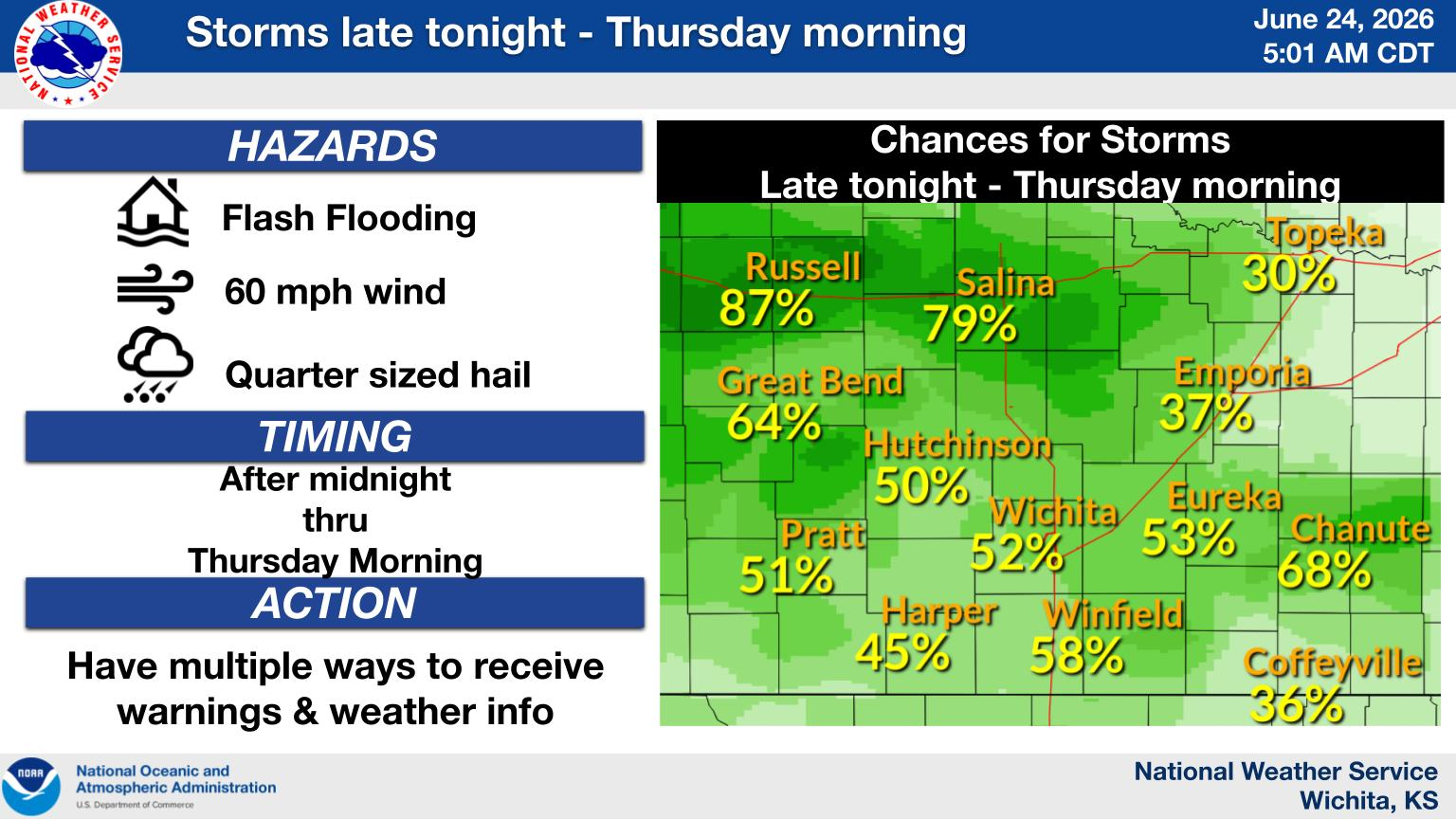
- Expect a slight chance of showers and thunderstorms this morning in Salina, but it will turn partly sunny later today with a high near 83°F.
Click here for local obituaries
Click here for local jail logs
🌾 Kansas
-
Emporia's Planning Commission voted unanimously June 23 to table three zoning proposals for a gigawatt-scale data center after a 6½-hour hearing drew 400 to 500 residents, with a special meeting set for June 30. →
-
Kansas AFL-CIO unanimously endorsed state Sen. Ethan Corson for governor June 23, sparking a dispute with rival Democratic candidate Sen. Cindy Holscher over union membership ahead of the August 4 primary. →
-
Kansas unemployment fell to 3.8% in May, down from 3.9% in April, with nonfarm payroll employment rising by 5,100 jobs, the state Department of Labor reported June 23. →
-
Kansas funded only 67% of special education excess costs last year, falling $226 million short of the statutory 92% target, according to the Kansas State Department of Education. →
-
Fort Hays State University paused its men's and women's golf programs June 23 following a $2.4 million state funding cut, though the university said it will honor all existing scholarships for the 2026-27 academic year. →
🇺🇸 US
-
Congress passed the 21st Century Road to Housing Act on June 23, sending the most ambitious federal housing legislation since the 1980s to President Trump, who has pledged to sign it; the House approved the measure 358-32 after the Senate passed it 85-5. →
-
Director of National Intelligence Tulsi Gabbard released declassified documents June 18 alleging Anthony Fauci helped shape intelligence-community assessments of COVID-19's origins and lied to Congress in 2024 about his contacts with U.S. intelligence agencies. →
-
The Supreme Court ruled 6-3 June 23 in Landor v. Louisiana Department of Corrections that former inmates cannot sue individual prison officials for money damages under the Religious Land Use and Institutionalized Persons Act, blocking a Rastafarian man's suit after guards shaved his dreadlocks days before his release. →
-
Iran's growing use of China's yuan-based financial system is undermining U.S. sanctions leverage as nuclear negotiations proceed, with Chinese refiners shifting to yuan-settled oil purchases that bypass the American-led banking system. →
-
The U.S. and Iran publicly clashed June 23 over whether Tehran agreed to readmit IAEA inspectors as part of a war-ending deal, while IAEA Director General Rafael Grossi said June 24 that inspectors will visit Iranian enrichment sites under the interim agreement's memorandum of understanding. →
Weather
JUNE 24, 1993: UNABOMBER MAIL BOMB SERIOUSLY INJURES YALE PROFESSOR
On this day, Yale computer science professor David Gelernter was gravely wounded when a mail bomb from the Unabomber exploded in his office. The attack was part of Ted Kaczynski’s long-running bombing campaign targeting universities and airlines, meant to dramatize his belief that modern industrial-technological society was dehumanizing and destroying both nature and human freedom. His manifesto, Industrial Society and Its Future, argued that advanced technology inevitably leads to pervasive social control, loss of autonomy and environmental ruin, and called for a revolutionary rejection of the industrial system rather than reforming it.