Top 5 US news stories
June 24 2026


Congress Passes Sweeping Housing Bill, Sends It to Trump
Gabbard Releases Documents Alleging Fauci Shaped COVID Intelligence
Supreme Court Blocks Rastafarian Man's Suit Over Shaved Dreadlocks
China's Yuan Erodes US Sanctions Leverage Over Iran
US and Iran Split on Inspections as IAEA Vows Site Visits
Congress Passes Sweeping Housing Bill, Sends It to Trump
Congress on June 23, 2026, passed the 21st Century Road to Housing Act, sending its most ambitious housing legislation since the 1980s to President Donald Trump, who has said he will sign it. The House approved the measure 358-32, a day after the Senate passed it 85-5, with all 32 no votes coming from Republicans and every Democrat present voting yes. The package bundles more than 50 provisions aimed at lowering housing costs primarily by expanding supply, including easing federal barriers to building, promoting manufactured homes, and pressing local governments to loosen zoning and permitting rules. In one of its most contested measures, the bill limits how many single-family homes large institutional investors can own and requires them to disclose their holdings. The legislation offers no new funding for affordable-housing projects and faces economic headwinds such as elevated mortgage rates and higher construction and materials costs. Home builders have responded cautiously, noting that the rules must be administered at the state and local levels and warning that local bottlenecks could blunt the bill's impact.
NPR / NBC News / CNN / WSJ
Gabbard Releases Documents Alleging Fauci Shaped COVID Intelligence
Director of National Intelligence Tulsi Gabbard on June 18, 2026, released declassified materials from her office alleging that Anthony Fauci helped shape intelligence-community assessments of COVID-19's origins. The Office of the Director of National Intelligence said the records show Fauci maintained contacts with intelligence officials and that he lied to Congress in 2024 when he denied knowledge of discussions with U.S. intelligence agencies about viral research. The release further alleges that Fauci steered the intelligence process toward a natural-origin assessment by recommending selected outside experts, some with funding ties to the National Institute of Allergy and Infectious Diseases. ODNI said Gabbard's office also gathered whistleblower testimony alleging retaliation against analysts who challenged the intelligence community's conclusions about the virus's origins. The materials were released as part of what ODNI described as a yearlong declassification review. The Senate confirmed Gabbard as director of national intelligence in a 52-48 vote on February 12, 2025.
ODNI
Supreme Court Blocks Rastafarian Man's Suit Over Shaved Dreadlocks
The U.S. Supreme Court on June 23, 2026, ruled 6-3 in Landor v. Louisiana Department of Corrections that a former inmate cannot seek money damages from individual prison officials under the Religious Land Use and Institutionalized Persons Act, a 2000 federal law protecting prisoners' religious practice. Damon Landor, a devout Rastafarian who had grown his dreadlocks for nearly two decades, said guards handcuffed him and shaved his head days before his release after he handed them a court ruling stating that his hair was religiously protected, which they discarded. Writing for the majority, Justice Neil Gorsuch reasoned that because the law was enacted under Congress's spending power, it cannot impose personal financial liability on officials who never consented to be sued. Justice Ketanji Brown Jackson dissented, arguing that the decision undermines the law's core purpose of forcing prisons to respect inmates' faith. The ruling does not erase the law's protections but sharply limits how prisoners can enforce them.
CNN / CBS News / SCOTUSblog / NBC News
China's Yuan Erodes US Sanctions Leverage Over Iran
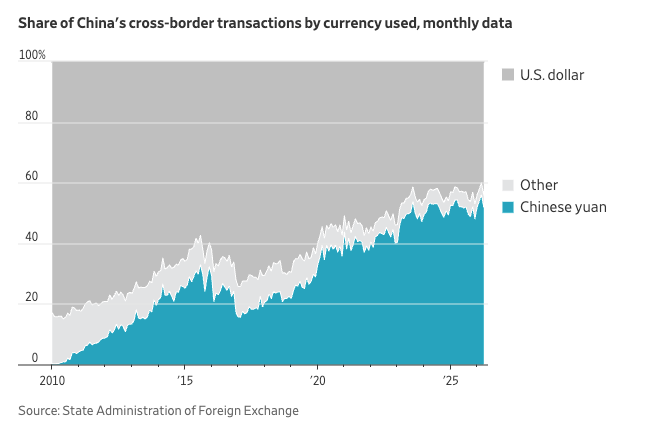
The White House has opened talks with Iran over a new nuclear deal, relying on the promise of sanctions relief and access to some of roughly $100 billion in frozen assets. That leverage is weakening as Tehran increasingly routes its business through China's financial system, which is built on the yuan and operates beyond Washington's reach. The shift was evident in late April, when the United States escalated its Economic Fury sanctions campaign and penalized a major Chinese refiner, Hengli Petrochemical, that it said had bought billions of dollars of Iranian oil. The refiner said its supplier had guaranteed the oil was not Iranian but added that future purchases would be settled in yuan rather than U.S. dollars, making the flows harder to track. The dollar, used in roughly 80% of international trade finance, has long given Washington an advantage because most dollar transactions must be settled by American banks that can monitor and cut off users. When U.S. adversaries transact in yuan, those payments bypass the American-led banking system, eroding that power.
WSJ
US and Iran Split on Inspections as IAEA Vows Site Visits
The United States and Iran clashed publicly on June 23, 2026, over whether Tehran has agreed to readmit International Atomic Energy Agency inspectors as part of a deal to end their war. President Trump insisted that Iran would allow inspections of its nuclear sites despite what he called false statements to the contrary, while Iran's Foreign Ministry denied that it had begun nuclear talks or invited inspectors back. Mediators said the two sides separately agreed to establish a communications line to prevent incidents in the Strait of Hormuz and ensure safe passage for commercial vessels. On June 24, 2026, IAEA Director General Rafael Mariano Grossi said that inspectors will visit Iranian enrichment sites, speaking at the Fukushima Daiichi plant in Japan. Grossi said the memorandum of understanding underpinning the interim deal requires IAEA supervision of nuclear-material facilities, and Iran had not immediately responded to his remarks. Talks are expected to continue in the coming days.
NPR / AP
JUNE 24, 1993: UNABOMBER MAIL BOMB SERIOUSLY INJURES YALE PROFESSOR
On this day, Yale computer science professor David Gelernter was gravely wounded when a mail bomb from the Unabomber exploded in his office. The attack was part of Ted Kaczynski’s long-running bombing campaign targeting universities and airlines, meant to dramatize his belief that modern industrial-technological society was dehumanizing and destroying both nature and human freedom. His manifesto, Industrial Society and Its Future, argued that advanced technology inevitably leads to pervasive social control, loss of autonomy and environmental ruin, and called for a revolutionary rejection of the industrial system rather than reforming it.
Found a mistake? Have a news tip or feedback to share? Contact our newsroom using the button below:
citizen journal offers three flagship products: a daily national news summary, a daily Kansas news summary, and local news and school board summaries from 34 cities across 5 states. Use the links in the header to navigate to national, kansas, and local coverage. Subscribe to each, some, or all to get an email when new issues are published for FREE!
Brought to you by (click me!)
Sources
