Top 5 US news stories
May 13 2026


April Inflation Hits 3.8%, Highest in Three Years
Trump Arrives in Beijing Tonight on First China Visit in Nearly a Decade
Average Student Loan Defaulter Is Now Nearly 40 Years Old
Colleges Abandon Honor Codes as AI Cheating Spreads
Truck Convoys Across Arabia Become Global Trade Lifeline
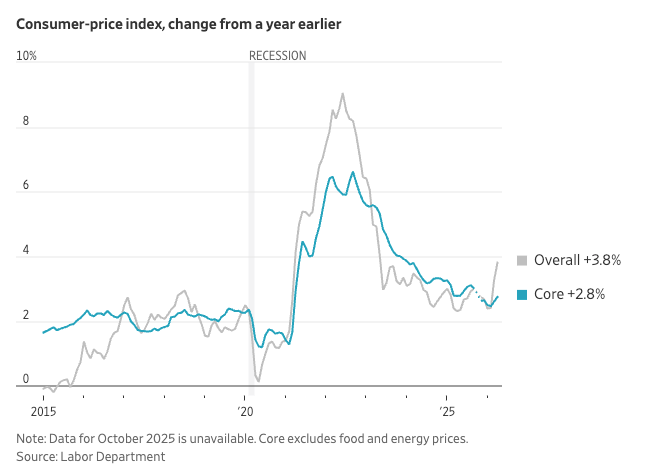
April Inflation Hits 3.8%, Highest in Three Years
Consumer prices rose 3.8% in April from a year earlier, the largest annual increase in three years, the Labor Department reported Tuesday. The figure surpassed economists' forecasts of 3.7% and the previous month's 3.3% reading, reflecting higher gas prices since the start of the war with Iran. Core inflation, which excludes food and energy, rose 2.8%, up from 2.6% the prior month and slightly above the 2.7% economists had predicted. Some economists said tariffs President Trump announced a year ago are still filtering through to goods prices, but the Iran war has presented a quicker and more obvious shock that could be harder to reverse. Price increases have been especially sharp for items consumers buy frequently, including coffee and gasoline.
WSJ
Trump Arrives in Beijing Tonight on First China Visit in Nearly a Decade
President Donald Trump arrives in Beijing tonight for his first visit to China in nearly a decade, marking a notable shift from the anti-China trade posture he has carried since his 2016 campaign. Long an outspoken critic of Chinese trade policies he says have stolen American jobs and opportunities, Trump appears prepared to embrace the ceremony of meeting with Chinese leader Xi Jinping. Chinese officials have opened centuries-old monuments including the Temple of Heaven and the Forbidden City for the president's visit. The trip comes as the administration navigates ongoing tensions over Taiwan, trade and the war with Iran.
Washington Post
Average Student Loan Defaulter Is Now Nearly 40 Years Old
The average American defaulting on student loans is now nearly 40 years old, roughly two and a half years older than the typical defaulter before the pandemic, according to research published Tuesday by the Federal Reserve Bank of New York. Borrowers age 50 and older are now at higher risk of default than younger borrowers, the Fed found. More than 3.5 million people defaulted between October and March, after a pandemic-era pause on repayments ended in 2023 and the federal government resumed collections. The share of student-loan balances past due has climbed to just over 10%, approaching pre-pandemic levels, with defaulters concentrated in the South but appearing across the country. Many defaulted borrowers are also struggling with other debts: nearly 40% with auto loans are past due, 56% with at least one credit card are past due and 20% with a mortgage are past due. Researchers said some defaulters are likely parents who borrowed on behalf of their children.
WSJ
Colleges Abandon Honor Codes as AI Cheating Spreads
Colleges across the country are abandoning long-standing trust-based exam policies as generative AI tools make academic cheating both easier and harder to detect. Princeton University faculty voted Monday to require proctoring in all in-person exams beginning this summer, reversing an honor code dating to 1893 that had allowed unproctored testing for more than 130 years. Nationwide, a third of students admit to using artificial intelligence to produce entire assignments, according to Christian Moriarty, an ethics and law professor at St. Petersburg College and a director at the International Center for Academic Integrity. A student newspaper survey of more than 500 Princeton seniors last year found 30% had cheated on an assignment or exam, while nearly half reported knowledge of an honor-code violation but less than 1% filed a report. Professors elsewhere have turned to blue books, oral exams and AI-detection software, while students increasingly run their own essays through AI detectors before submission to avoid getting flagged.
WSJ
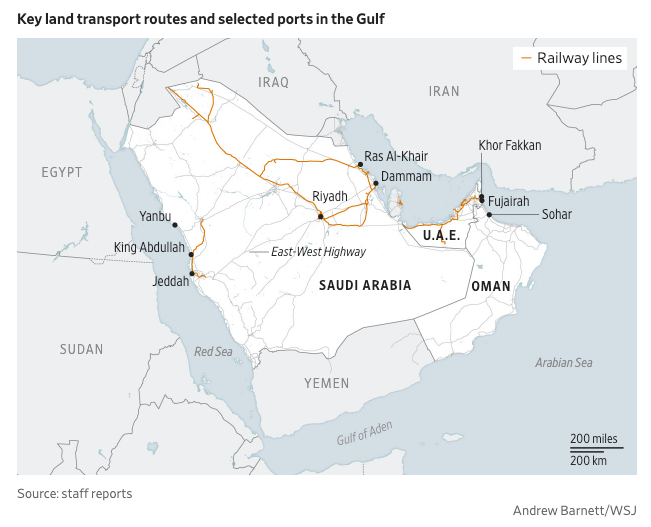
Truck Convoys Across Arabia Become Global Trade Lifeline
Trucking convoys across the Arabian desert have emerged as a critical workaround for global trade after U.S. and Israeli strikes on Iran disrupted shipping through the Strait of Hormuz. Highways, railroads and ports in Saudi Arabia, the United Arab Emirates and Oman are moving goods that previously transited the waterway, with Saudi state-controlled mining company Maaden alone running roughly 3,500 trucks from the Persian Gulf to the Red Sea, up from 600 before the conflict. Maaden chief executive Bob Wilt said the company expects to clear its fertilizer export backlog by the end of May, easing a shortage that had threatened the global food supply. Shipping firms including MSC and Maersk have also begun trucking cargo across the peninsula, though the overland routes cannot match the capacity or cost of sea shipping and do not address shortages of jet fuel and other energy products. With U.S.-Iran talks deadlocked, the conflict has devolved into an economic war of attrition, and the new logistics map is helping contain global inflation while giving Gulf governments time to wait out negotiations.
WSJ
MAY 13, 1920: SOCIALIST PARTY NOMINATES IMPRISONED LEADER EUGENE V. DEBS FOR PRESIDENT
The Socialist Party selected Debs as its presidential nominee even though he was serving a 10-year federal prison sentence for violating wartime speech laws. Campaigning as “Convict 2253,” Debs ran from behind bars and went on to win more than 900,000 votes in the November election.
Found a mistake? Have a news tip or feedback to share? Contact our newsroom using the button below:
citizen journal offers three flagship products: a daily national news summary, a daily Kansas news summary, and local news and school board summaries from 34 cities across 5 states. Use the links in the header to navigate to national, kansas, and local coverage. Subscribe to each, some, or all to get an email when new issues are published for FREE!
Brought to you by (click me!)
Sources
