Top 5 Kansas news stories
October 30 2025


China Resumes US Soybean, Other Ag Purchases After Trump-Xi Meeting
U.S.-China “Phase One” Deal Fell Short of Promises Six Years Later
Farm Country Paid Steep Price as China Weaponized Trade War, Triggering Bailout
Lawrence Schools Switch Surveillance Software While Facing Student Spying Lawsuit
Engineer Challenges Traffic Safety Assumptions at Kansas Summit
1. China Resumes US Soybean, Other Ag Purchases After Trump-Xi Meeting
China has agreed to immediately purchase large quantities of American soybeans and other agricultural products following a Thursday meeting between President Donald Trump and Chinese President Xi Jinping in South Korea, bringing relief to U.S. farmers who feared losing their largest export market. The soybean agreement was among several deals reached during the leaders' first face-to-face talks since Trump returned to office in January, including reduced fentanyl tariffs to 10 percent, China's commitment not to impose rare earth controls for one year, and discussions on Nvidia chip exports to China.
2. U.S.-China “Phase One” Deal Fell Short of Promises Six Years Later
When the Trump administration announced its “Phase One” trade deal with China in early 2020, it was billed as a breakthrough to reset the trade relationship after two years of escalating tariffs. The agreement promised sweeping Chinese purchases of American goods and services—an additional $200 billion over 2017 levels across manufacturing, energy, agriculture, and services—along with stronger protections for intellectual property and reduced barriers for U.S. firms. In return, the U.S. paused new tariff hikes and trimmed duties on $120 billion of imports. The deal was meant to mark a turning point, signaling that diplomacy could replace confrontation in managing the world’s two largest economies. Six years later, most of those expectations have gone unfulfilled. Analysts estimate China fell about 19 percent short of the $200 billion purchase target, while key structural reforms remain largely aspirational. Meanwhile, instead of easing, tariffs have hardened into a new normal: average duties on Chinese goods today hover near 45 percent—roughly fifteen times higher than before the trade war began. The U.S. goods deficit with China remains wide, and companies on both sides have restructured supply chains to limit exposure rather than expand trade. What began as a “Phase One” détente has effectively become a semi-permanent decoupling.
 Greg Loving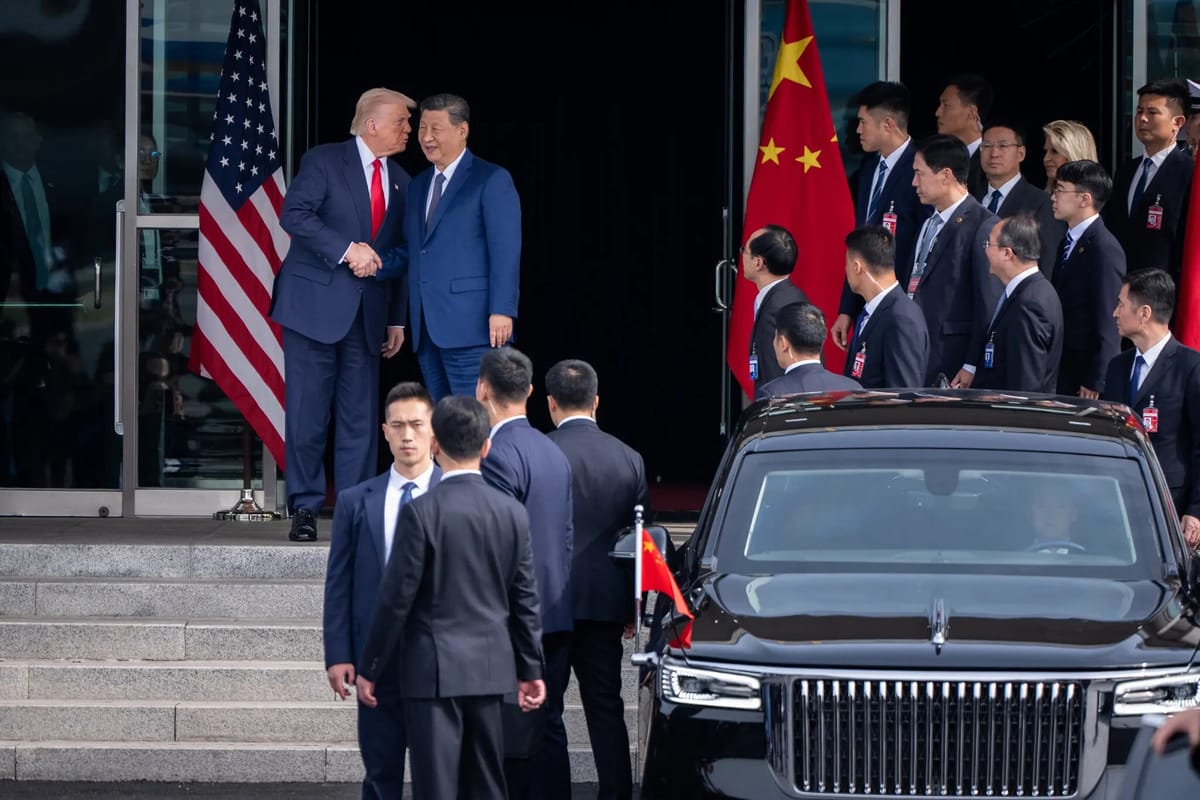
3. Farm Country Paid Steep Price as China Weaponized Trade War, Triggering Bailout
American farmers bore some of the steepest costs. Retaliatory Chinese tariffs slashed U.S. soybean and grain exports during the height of the trade war, prompting the federal government to roll out roughly $28 billion in emergency aid in 2018 and 2019, followed by another $16 billion in 2020 to stabilize rural incomes. Although agricultural exports have since recovered somewhat, the flow remains below pre-trade-war expectations, and the promised surge in Chinese purchases of farm products never materialized at the scale envisioned. For Beijing, targeting U.S. farm exports was a deliberate form of political pressure. Agricultural states that form the heart of “farm country” overwhelmingly supported Donald Trump in 2016, 2020 and 2024, giving China leverage to weaponize trade restrictions against a key segment of his political base. While many farmers still express loyalty to Trump’s combative stance toward China, the economic pain from disrupted exports and reliance on federal aid underscore how global trade tensions now reach deep into America’s rural heartland.
4. Lawrence Schools Switch Surveillance Software While Facing Student Spying Lawsuit
The Lawrence public school district replaced its student surveillance software from Gaggle to ManagedMethods for the new school year while asking a federal judge to dismiss a lawsuit brought by students accusing officials of unconstitutional spying on students, including high school journalists. The district argued the case should be dismissed because it stopped using Gaggle, but failed to disclose it now uses ManagedMethods, which offers the same AI-powered monitoring of student devices, files, emails and online accounts that companies promise will ensure student safety despite academic research questioning the software's effectiveness and raising concerns about potential harm to students' learning and mental health.
5. Engineer Challenges Traffic Safety Assumptions at Kansas Summit
Civil engineer Wes Marshall told participants at the Walk Bike Roll Kansas summit in Lawrence that U.S. transportation agencies make life-or-death decisions based on flawed data and unproven assumptions about traffic safety, contributing to nearly 4 million traffic fatalities since 1899. The University of Colorado-Denver professor, speaking at the Kansas Department of Transportation-hosted event Wednesday, said addressing the carnage requires abandoning the dominant focus on vehicle traffic flow and building safer streets based on actual research rather than assumptions about speed limits, lane widths and pedestrian infrastructure.
Sources
- South China Morning Post
- citizen journal
- citizen journal
- Kansas Reflector
- Kansas Reflector
Found a mistake? Have a news tip or feedback to share? Contact our newsroom using the button below:
citizen journal offers three flagship products: a daily national news summary, a daily Kansas news summary, and local news and school board summaries from 12 cities across Kansas. Each issue contains 5 paragraph-length stories that are made to be read in 5 minutes. Use the links in the header to navigate to national, kansas, and local coverage. Subscribe to each, some, or all to get an email when new issues are published for FREE!
Brought to you by (click me!)
