Lawrence daily brief
Lawrence, Kansas and US news for busy people - Jun 26, 2026 edition


Lawrence
- The Lawrence Environmental Sustainability Advisory Board is considering recommending a ban on Styrofoam food containers in the city. →
- The Lawrence Environmental Sustainability Advisory Board proposed an e-bike share program and extending local bus operating hours. →
- The Lawrence Environmental Sustainability Advisory Board proposed tracking community-wide energy consumption using data from Evergy. →
- The Lawrence Environmental Sustainability Advisory Board wants the Lawrence City Commission to lobby the state for community solar. →
- Lawrence city staff explained that transitioning to a multi-stream recycling model is currently unfeasible due to existing equipment. →
- citizen journal launched a preview of its House 2 Home real estate platform connecting agents and listings in McPherson and Hutchinson. →
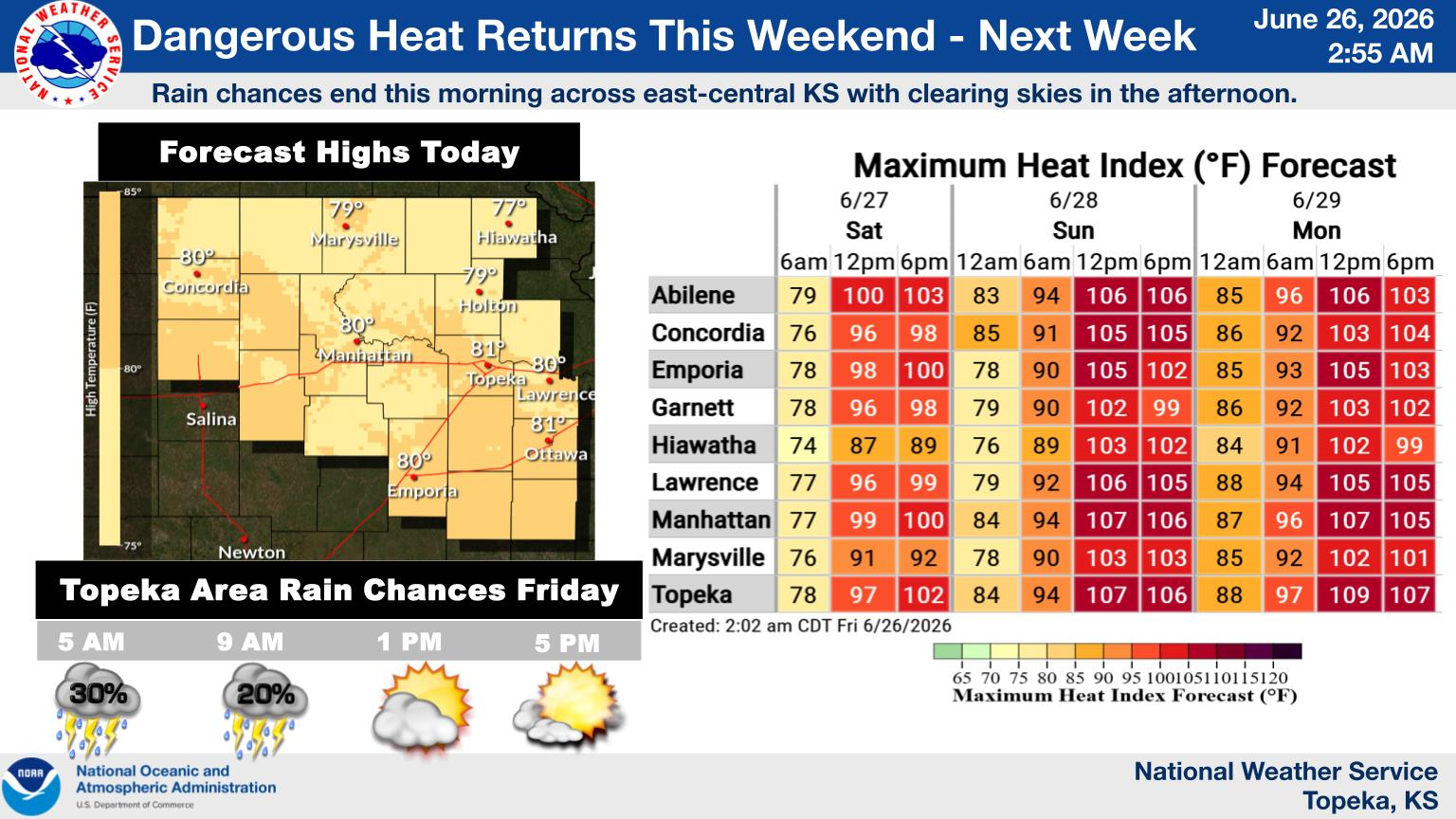
- Expect patchy morning fog to give way to mostly cloudy skies with a high near 80°F and just a slight chance of a passing shower.
Click here for local obituaries
Click here for local jail logs
🌾 Kansas
-
Kansas Insurance Commissioner Vicki Schmidt proposed June 25 that social media platforms be barred from allowing Kansans under 16 to create or maintain accounts without parental consent, placing the compliance burden on companies rather than parents or schools. →
-
Kansas's three Democratic gubernatorial candidates diverged sharply on data centers June 25, with Sen. Cindy Holscher calling for a statewide construction moratorium while Overland Park Mayor Curt Skoog opposed a halt and Gov. Laura Kelly-backed Sen. Ethan Corson emphasized schools and tax relief. →
-
The Trump administration has unfrozen U.S. Department of Energy funding for University of Kansas research aimed at breeding corn varieties that require significantly less fertilizer, a project paused when the administration took office in 2025. →
-
U.S. Marshals arrested Latron Wesley-Osayande, 28, in Topeka on June 25 on a first-degree murder warrant connected to the April 11 fatal shooting of William Johnson in Wichita, with bond set at $1 million. →
-
University of Kansas baseball coach Dan Fitzgerald was named Baseball America's national College Coach of the Year on June 24, one day after KU guard Darryn Peterson was selected No. 2 overall by the Utah Jazz in the NBA Draft — the highest KU pick since Andrew Wiggins went first overall in 2014. →
🇺🇸 US
-
The Supreme Court ruled 6-3 in Mullin v. Al Otro Lado that migrants who fail to step onto U.S. soil cannot apply for asylum, reviving restrictive border policies and potentially affecting hundreds of thousands of people annually. →
-
The Commerce Department revised first-quarter 2026 U.S. GDP growth upward to 2.1%, while May PCE inflation data showed prices rising 4.1% year-over-year, the Fed's preferred gauge. →
-
Iran's Revolutionary Guard struck the Singapore-flagged cargo ship Ever Lovely with a drone in the Strait of Hormuz on June 25, prompting the UN's International Maritime Organization to pause its vessel evacuation plan pending new safety guarantees. →
-
Satellite imagery and interviews reveal Iranian missiles and drones caused extensive damage to US Naval Support Activity Bahrain between late February and June, damage the Pentagon had not publicly acknowledged, prompting a U.S. reassessment of its Middle East military footprint. →
-
Türkiye defeated the U.S. men's national team 3-2 on a stoppage-time goal June 25, handing the host nation its first 2026 World Cup loss, though the U.S. still advances to the knockout round. →
Weather
JUNE 26, 1956: CONGRESS APPROVES FEDERAL-AID HIGHWAY ACT
The Federal-Aid Highway Act funded the construction of 41,000 miles of interstate highways, launching the largest public works project in U.S. history. The new interstate system reshaped the national economy by supercharging trucking, enabling just-in-time shipping, and fueling growth in roadside businesses, suburbs, and auto manufacturing. Its legacy is a deeply integrated national market and car-centered landscape, but also the decline of rail, the disruption of small towns and farms, and enduring debates over land use and urban design.