Trump Pairs New Policy Proposals With Midterm Battle Lines in State of the Union
Address blends AI energy pledge, retirement plan and fraud crackdown with unprecedented awards and pointed confrontations with Democrats

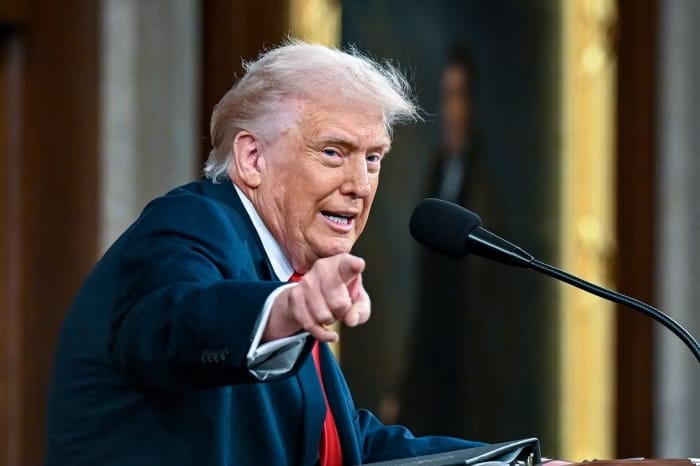
WASHINGTON — President Donald Trump used his sixth address to a joint session of Congress Tuesday night to announce a slate of new domestic initiatives, including a "Ratepayer Protection Pledge" requiring technology companies building artificial intelligence data centers to construct their own power plants, a federally matched retirement savings plan for the roughly 50 percent of private-sector workers who lack employer-sponsored accounts, and an anti-fraud campaign to be led by Vice President JD Vance. The proposals came as data center electricity demand is projected to double by 2028, according to the International Energy Agency, raising concerns that AI expansion could drive up consumer utility bills. Trump told lawmakers the energy pledge would ensure "no one's prices will go up, and in many cases, prices of electricity will go down."
The retirement proposal would offer workers without employer matching contributions access to a plan modeled on the federal Thrift Savings Program, with the government matching up to $1,000 per year. Bureau of Labor Statistics data show that roughly 40.6 million full-time workers currently have no access to any employer-sponsored plan. Trump also formally launched what he called a "war on fraud," to be led by Vice President JD Vance, citing government benefit fraud in Minnesota at a scale that significantly exceeds documented cases and official estimates.
In an unprecedented display, Trump presented seven military and civilian awards during the address. The centerpiece was two Congressional Medals of Honor — the first ever awarded during a State of the Union. Chief Warrant Officer Eric Slover, visibly injured and assisted to his feet with a walker, received his for the January raid that captured Venezuelan leader Nicolás Maduro. Retired Navy Capt. Royce Williams, 100, received his for a classified 1952 Korean War dogfight. Trump also presented the Presidential Medal of Freedom to Olympic hockey goaltender Connor Hellebuyck, a Legion of Merit to Coast Guard Petty Officer Scott Ruskin for saving 165 people during the July 4th, 2025, Texas flood on his first rescue mission, and Purple Hearts to two West Virginia National Guard members shot near the White House by an Afghan national — Specialist Sarah Beckstrom, who was killed, and Staff Sergeant Andrew Wolfe, who survived and was present in the gallery. In total, Trump recognized 27 individuals and groups by name, roughly double the typical number. The speech's 1-hour-and-47-minute runtime was the longest State of the Union on record.
Throughout the address, Trump repeatedly framed congressional Democrats as an obstacle to public safety, staging a series of stand-or-sit confrontations designed to produce visual contrasts ahead of the 2026 midterm elections. He asked lawmakers to rise if they agreed that "the first duty of the American government is to protect American citizens, not illegal aliens," then narrated Democrats' refusal to stand: "You should be ashamed of yourself." He repeated the tactic on banning gender transitions for minors without parental consent, telling the chamber, "Look, nobody stands up. These people are crazy." Five of the 27 gallery guests were victims of crimes Trump attributed to Democratic immigration or criminal justice policies, including a five-year-old girl struck by a truck driven by an undocumented immigrant and a Ukrainian refugee killed on a Charlotte, North Carolina, train by a repeat offender released under a no-cash-bail program. Trump called on Congress to pass the "Save America Act" requiring voter identification and end most mail-in voting, asserting that Democrats oppose such measures "because they want to cheat."
The speech unfolded against the backdrop of a partial government shutdown, with Trump accusing Democrats of cutting all funding for the Department of Homeland Security. With midterm elections less than nine months away, the address signaled a strategy built on a central argument: that electing Democrats would mean a return to open borders and the violence Trump says followed. Virginia Gov. Abigail Spanberger opened the Democrats' response by criticizing what she said were Trump's lack of efforts to lower costs. "Is the president working to make life more affordable for you and your family?" she said. Republicans hold narrow majorities in both chambers, and the November elections will determine whether Trump retains the congressional allies he needs to enact the agenda he laid out Tuesday night.
Found a mistake? Have a news tip or feedback to share? Contact our newsroom using the button below: