Top 5 US news stories
December 17 2025

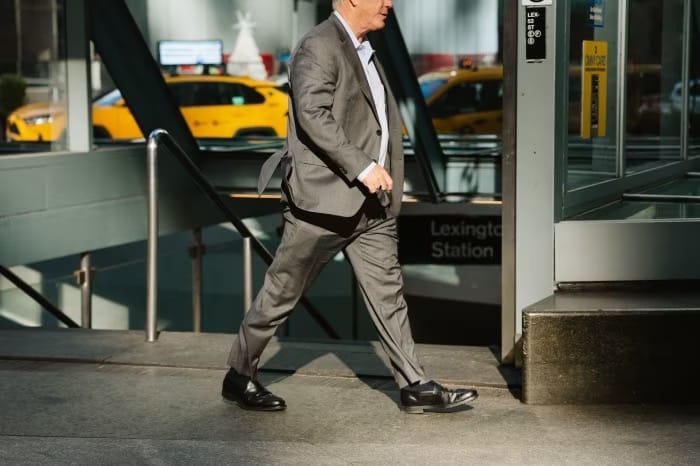
White-Collar Job Slump Drives Unemployment to Four-Year High, Deepening Economic Pessimism
Trump Orders Tanker Blockade, Choking Venezuela’s Oil Exports to Pressure Maduro
Rising Energy Prices and Cold Threatens to Spike Winter Heating Bills 9.2%: Forecast
Global Automakers Retreat from EV Targets as Competition from China and Relaxed Regulations Spur Return to Gasoline
Trump Expands Travel Ban to 20 Nations, Citing Security Concerns After Guard Shooting
President Donald Trump will deliver a prime-time address to the nation from the White House tonight at 9 p.m. ET (8 p.m. CT)…topic has not been announced…
1. White-Collar Job Slump Drives Unemployment to Four-Year High, Deepening Economic Pessimism
A. The US unemployment rate rose to 4.6 per cent in November, the highest level in more than four years, in a further sign of weakness in the labour market. The world’s biggest economy added 64,000 jobs in November but shed 105,000 in October, bolstering the case for the Federal Reserve to cut interest rates further in the new year.
B. Office workers are filled with anxiety. Tuesday’s jobs report was the latest ominous sign in an era of big corporate layoff announcements and chief executives warning that artificial intelligence will replace workers. The overall unemployment rate ticked up to 4.6%. Sectors with a lot of office workers, like information and financial activities, shed jobs in October and November. Hiring in many industries that employ white-collar workers has softened this year, according to Labor Department data, while the unemployment rate for college-educated workers has drifted higher. Fears about the job market are contributing to widespread pessimism about the economy. The University of Michigan’s index of consumer sentiment is near historic lows. College-educated workers who were once insulated from economic concerns aren’t anymore.
FT, WSJ
2. Trump Orders Tanker Blockade, Choking Venezuela’s Oil Exports to Pressure Maduro
A. President Trump on Tuesday ordered a “total and complete blockade” of all sanctioned oil tankers entering and leaving Venezuela, in a major escalation of his pressure campaign against the country’s leader, Nicolás Maduro.
B. The threat of another U.S. seizure has disrupted the country’s usually bustling traffic of dark-fleet vessels ferrying the Latin American country’s oil to China and Cuba. Several tankers are idling at Venezuelan ports, and others are veering away from the region, vessel-tracking data show. President Trump on Tuesday ordered a complete blockade of all sanctioned oil tankers going into and out of Venezuela, escalating his administration’s pressure campaign against strongman Nicolás Maduro. If Venezuela’s sanctioned oil traffic is stalled for long, a major revenue stream for Maduro would dry up. Crude sales have long represented more than 90% of Venezuela’s export income. “Venezuela is completely surrounded by the largest Armada ever assembled in the History of South America,” Trump said Tuesday on Truth Social.
WSJ
3. Rising Energy Prices and Cold Threatens to Spike Winter Heating Bills 9.2%: Forecast
Consumers already tapped out from rising home energy costs face yet another strain on their pocketbooks — surging heating costs. Higher electricity and natural gas prices coupled with forecasts for unusually cold temperatures across parts of the country are expected to drive up bills as winter takes hold. The average U.S. household is projected to spend nearly $1,000 this winter to heat its home, up 9.2 percent from a year earlier, according to the National Energy Assistance Directors Association, which represents state governments in securing federal money.
NYT
4. Global Automakers Retreat from EV Targets as Competition from China and Relaxed Regulations Spur Return to Gasoline
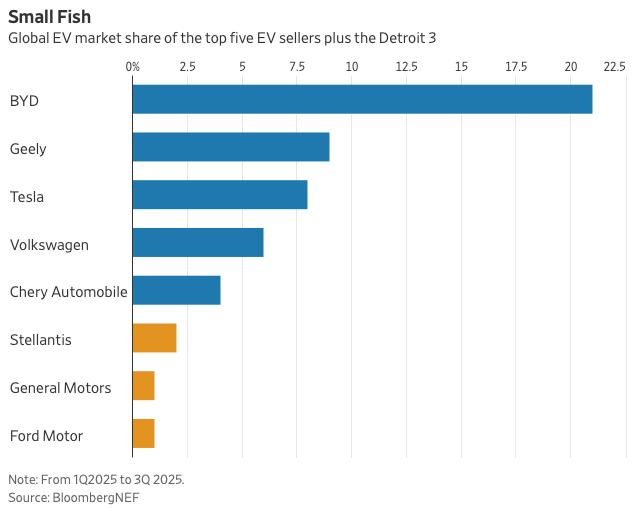
A. American automakers want to boost their profits by selling high-margin gas guzzlers today, all while not falling behind on electric-vehicle technology. It will be difficult to do both. Look at the list of regulatory changes this year, and it is all but impossible for U.S. automakers to not lean into selling big SUVs and trucks. Car manufacturers no longer face penalties for failing to meet federal fuel-economy standards, which are themselves also being revised to become less stringent. The $7,500 tax credit for buying EVs expired. California no longer has the ability to set its own tailpipe-emissions standards, which were a big driver of EV investment. BloombergNEF estimates that 24% fewer EVs will be sold in the U.S. in the fourth quarter of 2025 compared with a year earlier. It isn’t just the U.S. The European Union, U.K. and Canada are all pulling back or rethinking their ambitious EV mandates.
B. The last vehicle will roll off the assembly line at Volkswagen’s plant in Dresden, Germany, on Tuesday, marking the first time in the automaker’s 88-year history that it has closed a plant in its home country.
WSJ, NYT
5. Trump Expands Travel Ban to 20 Nations, Citing Security Concerns After Guard Shooting
President Trump on Tuesday expanded travel restrictions to include 20 more countries, just weeks after he promised to do so when authorities arrested an Afghan national in the shooting of two National Guard troops in Washington. The revised policy, which takes effect on Jan. 1, fully blocks travel for individuals from five additional countries — Syria, South Sudan, Niger, Mali and Burkina Faso — and also for people with documents issued by the Palestinian Authority. The Trump administration also added partial travel restrictions for individuals from 15 additional countries, predominantly in Africa. With the expansion, there are now more than 35 countries with U.S. travel restrictions.
NYT
December 17, 1903: First airplane flies
Near Kitty Hawk, North Carolina, Orville and Wilbur Wright make the first successful flight in history of a self-propelled, heavier-than-air aircraft on December 17, 1903. Orville piloted the gasoline-powered, propeller-driven biplane, which stayed aloft for 12 seconds and covered 120 feet on its inaugural flight.
We are temporarily pausing our podcasts as we revamp our app so any article can be read as audio
Found a mistake? Have a news tip or feedback to share? Contact our newsroom using the button below:
citizen journal offers three flagship products: a daily national news summary, a daily Kansas news summary, and local news and school board summaries from 29 cities across 5 states. Use the links in the header to navigate to national, kansas, and local coverage. Subscribe to each, some, or all to get an email when new issues are published for FREE!
Brought to you by (click me!)
Sources
- Financial Times
- Wall Street Journal
- Wall Street Journal
- Wall Street Journal
- New York Times
- Wall Street Journal
- New York Times
- New York Times
