Top 5 US news stories
December 11 2025

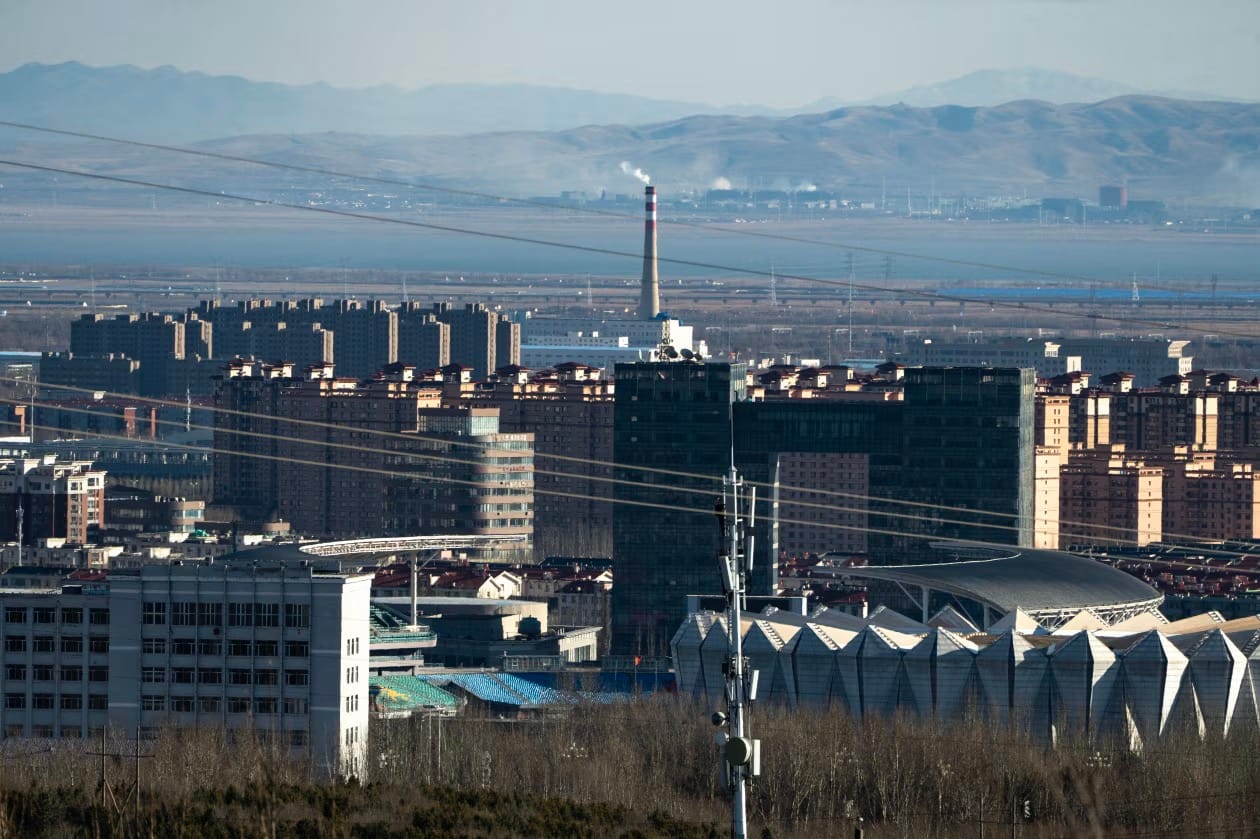
Record-Breaking Electricity Generation Fuels China’s AI Ambitions, Creating an “Electron Gap” with US
U.S. Forces Seize a Sanction-Evading Oil Tanker Off Venezuela, Escalating the Trump Administration's Pressure Campaign
Powell Pushes Through a Contentious Rate Cut Over Internal Dissent, Signaling Deep Fed Divisions That Complicates Future Easing
Vulnerable Republicans Break with Party Leadership to Back Affordable Care Act Extensions, Seeking to Avert Price Spikes
The Mexican Congress Approves 50% Levies on Chinese Goods, Moving to Shield Its Economy
1. Record-Breaking Electricity Generation Fuels China’s AI Ambitions, Creating an “Electron Gap” with US
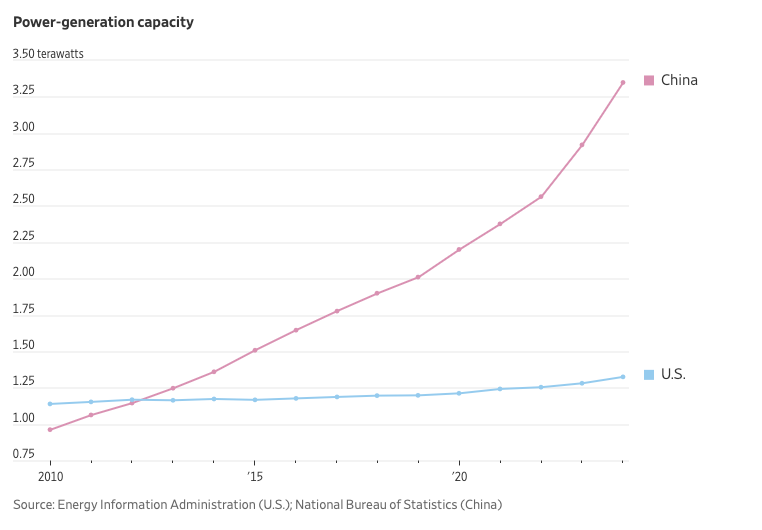
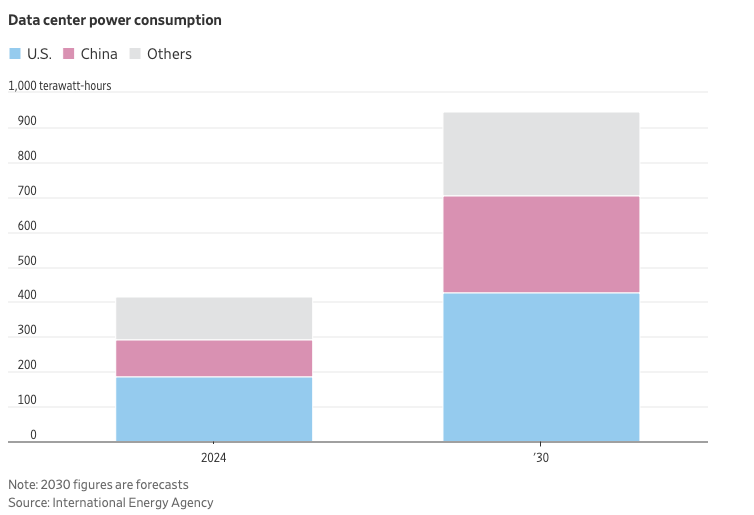
ULANQAB, China—The U.S. invented the most powerful artificial-intelligence models and controls access to the most advanced computer chips, but China has an ace to play in the global AI contest. China now has the biggest power grid the world has ever seen. Between 2010 and 2024, its power production increased by more than the rest of the world combined. Last year, China generated more than twice as much electricity as the U.S. Some Chinese data centers are now paying less than half what American ones pay for electricity. “In China, electricity is our competitive advantage,” Liu Liehong, head of China’s National Data Administration, said in March. The push for power supremacy is transforming remote expanses of Inner Mongolia, a Texas-like landscape of wide-open spaces now dotted with thousands of wind turbines and crisscrossed by transmission lines. They provide electricity for what officials describe as a new “cloud valley of the grasslands,” with more than 100 data centers in operation or on the way. That is just the beginning. Morgan Stanley forecasts that China will spend some $560 billion on grid projects in the five years through 2030, up 45% from the previous five years. Goldman Sachs predicts that by 2030, China will have about 400 gigawatts of spare capacity, about three times the world’s expected data-center power demand at that time. The U.S.-China “electron gap,” as OpenAI now calls it, has become a major preoccupation for American tech leaders. Microsoft Chief Executive Satya Nadella has said his company is worried it won’t have enough power to run the enormous number of chips it is buying. Some companies want Washington to do more to cut red tape or provide financial support to modernize America’s power grid. In the next three years, U.S. data centers could face an electricity shortfall of 44 gigawatts, the equivalent of New York state’s summertime capacity
WSJ
2. U.S. Forces Seize a Sanction-Evading Oil Tanker Off Venezuela, Escalating the Trump Administration's Pressure Campaign
A. The United States seized an oil tanker off the coast of Venezuela on Wednesday, a dramatic escalation in President Trump’s pressure campaign against Nicolás Maduro, the leader of Venezuela. Ms. Bondi said the operation included the F.B.I., the Department of Homeland Security and the Coast Guard, supported by the Pentagon. She said the tanker had been used to transport “sanctioned oil” from Venezuela and Iran. The U.S. officials said they expected additional seizures in the coming weeks as part of the administration’s efforts to weaken Mr. Maduro’s government by undermining its oil market. One of the officials identified the tanker as a vessel called the Skipper, and said it was carrying Venezuelan oil from Petróleos de Venezuela, the state-owned oil company known as PDVSA. The official said the ship had been previously linked to the smuggling of Iranian oil — a global black market that the Justice Department has been investigating for years. The vessel was sailing under the flag of another Latin American nation in which it was not registered, the official said, and its ultimate destination was Asia. A federal judge issued a seizure warrant roughly two weeks ago because of the ship’s past activities smuggling Iranian oil, not because of links to the Maduro government, the official said. Prosecutors have said that Iran uses money generated from oil sales to finance its military and the Islamic Revolutionary Guards Corps, which the United States has designated a terrorist entity.
B. The oil tanker seized by the United States off the coast of Venezuela on Wednesday may have been trying to conceal its whereabouts by broadcasting falsified location data, according to a New York Times analysis of satellite imagery and photographs.
NYT
CREDIT US Gov
3. Powell Pushes Through a Contentious Rate Cut Over Internal Dissent, Signaling Deep Fed Divisions That Complicates Future Easing
Jerome Powell pushed through a rate cut Wednesday over the broadest reservations of his nearly eight-year tenure, and in doing so, implicitly delivered a pointed message to President Trump and his own successor: Cutting rates is harder than it looks. The decision drew three dissents—two from officials who opposed any cut and one from a Trump ally who wanted a larger reduction. The formal vote understated the resistance. Four other officials registered a quieter objection in the Fed’s quarterly projections: They wrote down a higher interest rate for 2025 than the one the committee approved—a signal they wouldn’t have cut. Together with the dissenters, that is roughly a third of the policymakers who attend Fed meetings.
WSJ
4. Vulnerable Republicans Break with Party Leadership to Back Affordable Care Act Extensions, Seeking to Avert Price Spikes
WASHINGTON—A growing number of Republicans in both the House and Senate are breaking with party leaders and saying the GOP should extend expiring Affordable Care Act subsidies, seeing that as the only way to avert big cost increases for millions of households next year and buy time for a bigger overhaul. Republicans have fought for years to stop or curtail the 2010 health law, casting it as a failed program that props up big health insurers and fuels cost increases. But with enhanced ACA subsidies set to lapse next year, some Republicans across the political spectrum say they are willing to back a short-term extension. “I’d be open to doing it in the short-term until we fix the overall problem,” said Rep. Ronny Jackson (R., Texas), President Trump’s former White House physician. “I’d be willing to do it to bridge a gap.” Already, some GOP lawmakers have sponsored or signed onto bills that would extend the tax credits for one or more years, while including changes designed to crack down on fraud and limit eligibility to exclude higher-income households. They include Sens. Susan Collins (R., Maine), Jon Husted (R., Ohio) and Roger Marshall (R., Kan.)—all of whom are up for election next year—and vulnerable House Republicans like Reps. Rob Bresnahan (R., Pa.) and Mike Lawler (R., N.Y.). The Senate plans two healthcare votes Thursday: one on a GOP bill that would put as much as $1,500 a year into health savings accounts in lieu of providing subsidies to cover premiums, and the second on a Democratic plan that extends ACA subsidies for three years. Neither is expected to reach the 60 votes needed to advance, but the willingness of some Republicans to consider any form of ACA extensions has opened the door to possible talks if the partisan measures fail. In the House, Speaker Mike Johnson (R., La.) said Republicans plan to put on the floor next week a package of healthcare proposals that doesn’t include extending subsidies. But other lawmakers see an ACA extension as the only way to prevent widespread pain ahead of the 2026 midterms and get a GOP-led Congress in position to make more sweeping changes.
WSJ
5. The Mexican Congress Approves 50% Levies on Chinese Goods, Moving to Shield Its Economy
Mexico’s Congress authorized up to 50 percent tariffs on Chinese imports on Wednesday, a move seen as an effort to align Mexico with the United States amid pressure from Washington. On Wednesday morning, Mexico’s lower chamber of Congress approved the tariffs, which apply to China and other countries with which it does not have a trade deal. Mexico’s Senate then passed the bill in an expedited vote on Wednesday night. Seventy-six senators voted in favor versus only five against, while 35 abstained. President Claudia Sheinbaum, who proposed the tariffs in September, is widely expected to approve the legislation, which would then take effect in January. The tariffs would affect a wide variety of goods, including automotive parts, textiles, furniture, plastics, steel and aluminum. President Trump has been pressuring other nations to distance themselves from China, and the new Mexican tariffs would represent one of the biggest moves to do so yet.
NYT
December 11 1997: Kyoto Protocol first adopted in Japan
As of 2025, the world is far from meeting the Kyoto-era vision of cutting emissions below 1990 levels. Kyoto’s first commitment period (2008–2012) asked Annex I (developed) countries to reduce their emissions about 5% below 1990 levels, and in aggregate those developed countries ultimately cut their emissions by about 21% between 1990 and 2020—well beyond the minimum obligation. However, global greenhouse gas emissions overall have gone in the opposite direction: worldwide GHGs grew by roughly 50% from 1990 to 2021, and the latest inventories show they reached a new record in 2023—about 52–57 gigatons CO₂-equivalent, depending on accounting method, with estimates from EDGAR, Rhodium Group, and UNEP all indicating an all-time high. That contrast—deep cuts in many industrialized economies but large increases in rapidly growing economies—means that, taken globally, emissions today are well above levels consistent with Kyoto’s original targets.
We are temporarily pausing our podcasts as we revamp our app so any article can be read as audio
Found a mistake? Have a news tip or feedback to share? Contact our newsroom using the button below:
citizen journal offers three flagship products: a daily national news summary, a daily Kansas news summary, and local news and school board summaries from 29 cities across 5 states. Use the links in the header to navigate to national, kansas, and local coverage. Subscribe to each, some, or all to get an email when new issues are published for FREE!
Brought to you by (click me!)
Sources
- https://www.wsj.com/tech/china-ai-electricity-data-centers-d2a86935?mod=hp_lead_pos7
- https://www.nytimes.com/2025/12/10/us/politics/oil-tanker-seized-us-venezuela-trump.html
- https://www.nytimes.com/2025/12/10/us/politics/oil-tanker-venezuela-tracking-data.html
- https://www.wsj.com/economy/central-banking/feds-fractured-vote-signals-trouble-ahead-for-future-rate-cuts-d13f183f?mod=hp_lead_pos1
- https://www.wsj.com/politics/policy/some-republicans-break-with-leaders-in-healthcare-fight-362dc861?mod=hp_lead_pos11
- https://www.nytimes.com/2025/12/11/world/americas/mexico-tariffs-china.html
