Top 5 US news stories
December 4 2025


Soaring Markets Mint Nearly 300 New Billionaires in 2025
Nature Retracts High-Profile Climate Economic Study Citing Data Errors
Harvard’s Endowment Takes Hit as $500 Million Crypto Stake Slides
Cloud-Seeding Startup Battles Drought and ‘Chemtrail’ Conspiracy
Russia Gains Upper Hand in Drone War as Ukraine Counters with Aerial Dogfights
1. Soaring Markets Mint Nearly 300 New Billionaires in 2025
The total number of billionaires across the globe reached new heights in 2025, due partly to the soaring valuations of tech companies and rising stock markets, according to a new study by Swiss banking giant UBS. Some 2,900 billionaires now control $15.8 trillion, up from about 2,700 billionaires with a cumulative wealth of nearly $14 trillion a year earlier. The number and wealth of billionaires as a whole were boosted by the second-highest number of new billionaires minted in a year—287—since UBS began tracking that figure in 2015. Only 2021, with its flood of government stimulus and low interest rates that boosted the prices of assets, saw a higher number of new billionaires created.
WSJ
2. Nature Retracts High-Profile Climate Economic Study Citing Data Errors
In April 2024, the prestigious journal Nature released a study finding that climate change would cause far more economic damage by the end of the century than previous estimates had suggested. The conclusion grabbed headlines and citations around the world, and was incorporated in risk management scenarios used by central banks. On Wednesday, Nature retracted it, adding to the debate on the extent of climate change’s toll on society. The decision came after a team of economists noticed problems with the data for one country, Uzbekistan, that significantly skewed the results. If Uzbekistan were excluded, they found, the damages would look similar to earlier research. Instead of a 62 percent decline in economic output by 2100 in a world where carbon emissions continue unabated, global output would be reduced by 23 percent. Of course, erasing more than 20 percent of the world’s economic activity would still be a devastating blow to human welfare. The paper’s detractors emphasize that climate change is a major threat, as recent meta analyses have found, and that more should be done to address it — but, they say, unusual results should be treated skeptically.
NYT
3. Harvard’s Endowment Takes Hit as $500 Million Crypto Stake Slides
Things aren’t looking good for Harvard’s big bet on bitcoin. The country’s oldest and richest university supersized its wager on the cryptocurrency last quarter, ramping up its holdings in iShares Bitcoin Trust ETF to nearly half a billion dollars. Even after Tuesday’s rebound, bitcoin has dropped more than 20% this quarter—dragged down in a crypto rout hitting everyone from Wall Street to retail investors to holders of the U.S. president’s meme coin. Harvard could have gotten out unscathed—or even with a small gain—if the school had sold its holdings in early October, before prices dropped. The average price Harvard paid couldn’t be learned but if the school still holds some or all of the 4.9 million shares it bought last quarter, the best-case scenario would be a 14% loss on those holdings.
WSJ
4. Cloud-Seeding Startup Battles Drought and ‘Chemtrail’ Conspiracy
SALT LAKE CITY—Augustus Doricko, a mullet-wearing 25-year-old who commands a small army of meteorologists and drone pilots, stood in the parched foothills of the Uinta Mountains and squinted at the sky. The young CEO was overseeing one of the largest cloud-seeding projects in U.S. history. He watched two drones complete their missions and touch down on a cattle ranch below. Like generations before him, he was trying to make it rain. “This is what it’s all about,” said Doricko, who was running on two hours of sleep, coffee and nicotine patches. “If we don’t make more water for the Great Salt Lake, there’s going to be extraordinary problems.” Since the 1950s, water districts out West have used cloud seeding—which typically involves releasing silver iodide from planes or ground generators into clouds to boost snow or rain—to benefit farmers, ranchers and ski resorts, largely without controversy. Rainmaker, a startup that got an early boost from billionaire Peter Thiel, is updating that technology by using drones and AI-enhanced weather modeling to do this with more precision. Doricko’s goal is to use vastly expanded data collection and a fleet of drones piloted from the ground to make rainmaking more efficient, measurable and dependable. But an intractable problem keeps getting in the way: the conspiracy theory that the government is manipulating the weather. Doricko has received death threats and been confronted on the street by people who believe he’s part of such a plot—or an unwitting patsy. The head of Utah’s cloud-seeding program has also been targeted with threats. A small but growing faction of Americans believes the government and companies that collaborate with it are spraying toxic chemicals from jets, creating white “chemtrails”—a play on the “contrails” produced by the condensation of exhaust from jets—to poison the population or for other nefarious purposes.
WSJ
5. Russia Gains Upper Hand in Drone War as Ukraine Counters with Aerial Dogfights
A. The Russian drone hovered above the wounded Ukrainian soldier, ready to drop a bomblet to finish him off. Suddenly, a Ukrainian drone smashed into the Russian craft, blowing it up and saving the soldier. The close call showed the latest development in the futuristic aerial war shaping the front lines of Russia’s invasion of Ukraine: drone-on-drone battles. Drone pilots—like the one from Ukraine’s 3rd Separate Assault Brigade who swooped in this spring—fly interceptors at high speeds close to or into Russian drones and trigger an explosion to bring them down. Countering the enemy’s drones has become an critical challenge for both sides, as the craft have become the deadliest weapons menacing infantry and vehicles on the front lines. Soldiers use a variety of means—from nets and shotguns to electronic jammers and aging prop planes—to take out drones. Interceptor craft have become an important part of the mix in the past year or so. In September, the brigade’s drones intercepted 886 Russian drones, up from 507 in June. Around 50% of missions result in a successful interception, Boliukh said, compared with 5% a year ago. When an interceptor doesn’t hit its target, the operator is usually able to bring it back to be used again. Like many aspects of drone warfare introduced in this war, such interceptions will be a future component of combat, defense analysts say. Defense companies are rushing to develop their own interceptors. A company founded by Eric Schmidt, the former Google chief executive, provides one of Ukraine’s most popular.
B. Russia’s growing prowess at hitting Ukrainian supply lines with drones is the most important shift in the war in 2025, Ukrainian front-line fighters and analysts studying the conflict say—more significant than Russian forces’ incremental gains in territory. For most of the nearly four-year-old war, Ukraine has held a clear advantage in battlefield drones, using innovative tactics and technology to compensate for Russia’s greater manpower. But this fall, Russian forces have gained the upper hand in the tactical drone contest for the first time. They are outnumbering Ukraine’s unmanned aerial vehicles in key sections of the front, while using improved tactics that are testing Ukraine’s ability to keep its front-line defenders supplied.
WSJ
December 4 1992: President Bush orders U.S. troops to Somalia
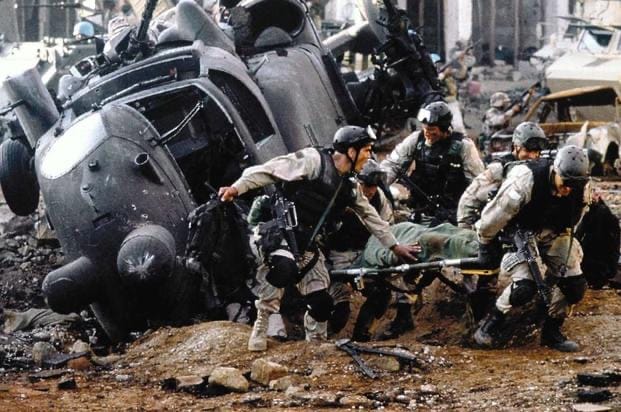
President George H.W. Bush orders 28,000 U.S. troops to Somalia, a war-torn East African nation where rival warlords were preventing the distribution of humanitarian aid to thousands of starving Somalis. In a military mission he described as “God’s work,” Bush said that America must act to save more than a million Somali lives, but reassured Americans that “this operation is not open-ended” and that “we will not stay one day longer than is absolutely necessary.” Unfortunately, America’s humanitarian troops became embroiled in Somalia’s political conflict, and the controversial mission stretched on for 15 months before being abruptly called off by President Bill Clinton in 1993.
On June 5, 24 1993, Pakistani U.N. peacekeepers inspecting a weapons storage site were ambushed and massacred by Somalia soldiers under the warlord General Mohammed Aidid. U.S. and U.N. forces subsequently began an extensive search for the elusive strongman, and in August, 400 elite U.S. troops from Delta Force and the U.S. Rangers arrived on a mission to capture Aidid. Two months later, on October 3-4, 18 of these soldiers were killed and 84 wounded during a disastrous assault on Mogadishu’s Olympia Hotel in search of Aidid. The bloody battle, which lasted 17 hours, was the most violent U.S. combat firefight since Vietnam. As many as 1,000 Somalis were killed.
Three days later, with Aidid still at large, President Clinton cut his losses and ordered a total U.S. withdrawal. On March 25, 1994, the last U.S. troops left Somalia, leaving 20,000 U.N. troops behind to facilitate “nation-building” in the divided country. The U.N. troops departed in 1995 and political strife and clan-based fighting continued in Somalia into the 21st century.
In 2025, President Donald Trump—who in 1993 was still a New York real estate developer—ignited a firestorm when he controversially tied Minnesota’s Somali community to fraud, seizing on high-profile welfare and pandemic-aid cases.
We are temporarily pausing our podcasts as we revamp our app so any article can be read as audio
Found a mistake? Have a news tip or feedback to share? Contact our newsroom using the button below:
citizen journal offers three flagship products: a daily national news summary, a daily Kansas news summary, and local news and school board summaries from 29 cities across 5 states. Use the links in the header to navigate to national, kansas, and local coverage. Subscribe to each, some, or all to get an email when new issues are published for FREE!
Brought to you by (click me!)
Sources
- https://www.wsj.com/economy/billionaires-wealth-worldwide-ubs-study-5c13f3da?mod=hp_lead_pos5
- https://www.nytimes.com/2025/12/03/business/economy/study-climate-damage-retracted.html
- https://www.wsj.com/us-news/education/harvards-big-wager-on-bitcoin-came-right-before-the-bust-ef80be76?mod=hp_lead_pos11
- https://www.wsj.com/us-news/climate-environment/chemtrails-conspiracy-theory-cloud-seeding-31eb1802?mod=hp_lead_pos7
- https://www.wsj.com/world/drones-fight-other-drones-in-the-battle-for-ukraines-skies-aa78dccb?mod=hp_lead_pos8
- https://www.wsj.com/world/russia-gains-the-upper-hand-in-the-drone-battle-once-ukraines-forte-803d242e?mod=Searchresults&pos=2&page=1
