Top 5 US news stories
April 8 2026

U.S. and Iran Agree to Two-Week Cease-Fire, Plan to Reopen Strait of Hormuz
Oil Plunges 13%, Global Stocks Surge as Cease-Fire Eases Energy Fears
Majority of Americans Now Say AI Will Do More Harm Than Good
Ford Asks Trump for Tariff Relief After Aluminum Plant Fires Squeeze F-150 Supply
Rail Freight Hits Post-Pandemic Highs, Signaling Broad Economic Strength
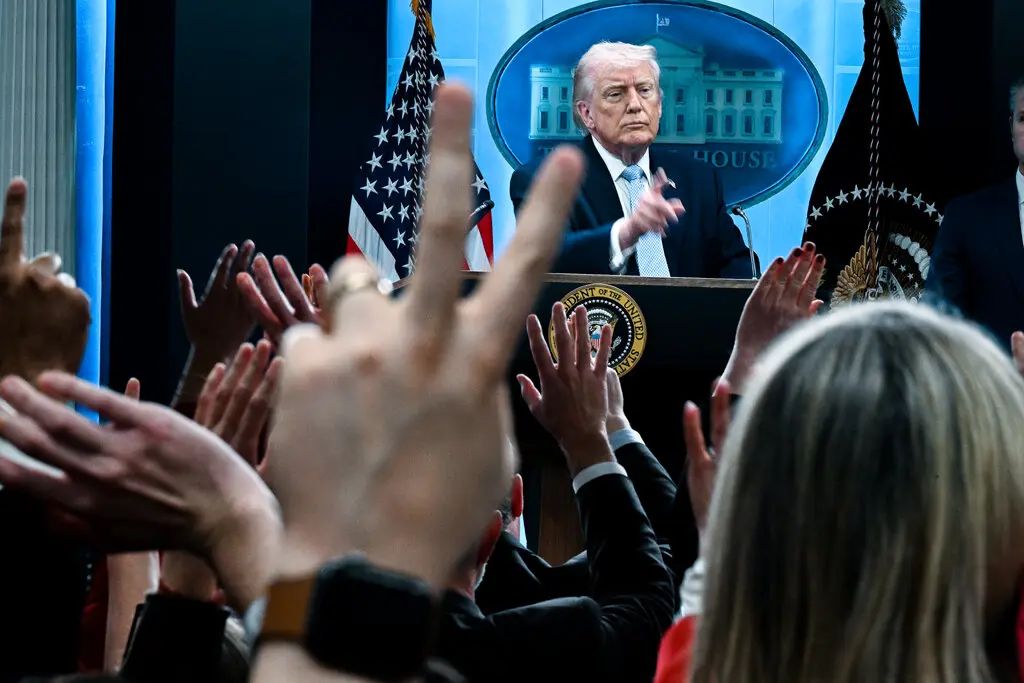
U.S. and Iran Agree to Two-Week Cease-Fire, Plan to Reopen Strait of Hormuz
The United States and Iran announced a two-week cease-fire and plans to fully reopen the Strait of Hormuz on Tuesday evening, hours before President Trump had threatened that Iran would see its "whole civilization" destroyed if it did not allow free transit through the vital waterway. The agreement, brokered by Pakistan, was hailed as a victory by both sides, with Trump calling a 10-point plan from Iran a "workable basis on which to negotiate" a lasting end to the war after weeks of demanding Tehran's unconditional surrender. Iranian First Vice President Mohammad Reza Aref declared on social media that "the era of Iran" had begun after Trump failed to topple the Islamic republic's government. Iran also committed to fully reopening the strait, which is critical for global oil and natural gas shipments, while negotiations proceed toward a permanent deal. It remained unclear whether word of the agreement had reached Iranian local commanders, as fresh Iranian attacks were reported in some Persian Gulf countries early Wednesday morning.
NYT
Oil Plunges 13%, Global Stocks Surge as Cease-Fire Eases Energy Fears
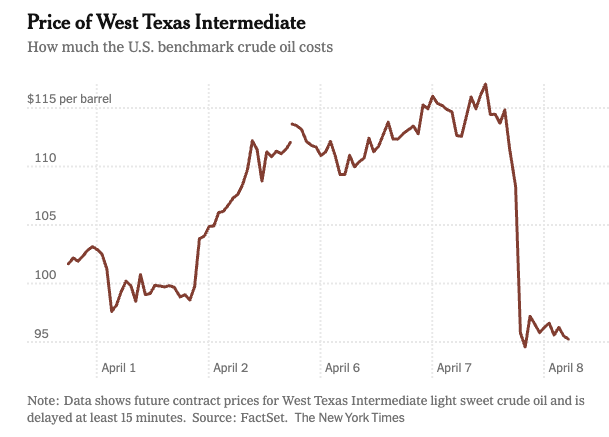
Oil prices plunged and global equities surged on Wednesday as investors cheered the last-minute cease-fire agreement, which offered hope that energy shipments from the Persian Gulf would resume soon. Brent crude fell roughly 13 percent to about $95 a barrel, while West Texas Intermediate dropped about 15 percent to around $96, though both benchmarks remain 30 to 40 percent above pre-war levels. Shipping traffic exiting the Persian Gulf through the Strait of Hormuz, which normally carries as much as one-fifth of the world's oil supply, has been effectively halted since the war began, and analysts caution that restoring the flow could take time. Asian markets posted major gains, with Japan's Nikkei 225 rising 5.4 percent, South Korea's Kospi climbing nearly 7 percent, and markets in Taiwan, Hong Kong, and mainland China all advancing sharply. The two-week cease-fire plan also includes a provision allowing both Iran and Oman to charge transit fees on ships passing through the strait, according to AP — a first for a passage the world had long treated as an international waterway free of tolls. The official said Iran would direct the revenue toward reconstruction, though it was not immediately clear how Oman would use its share.
NYT / AP
Majority of Americans Now Say AI Will Do More Harm Than Good
A new Quinnipiac poll finds that 55 percent of Americans now believe artificial intelligence will do more harm than good in their daily lives, an 11-point jump from a year ago and the first time the figure has crossed the majority threshold. Seventy percent say AI will reduce job opportunities, up 14 points, while just 7 percent believe it will increase them — a 10-to-1 ratio against. The pessimism persists even as adoption accelerates: the share of Americans who have used AI to research topics of interest rose from 37 to 51 percent over the past year, data analysis and image creation use cases each climbed from roughly 16 to 25 percent, and the share who say they have never used AI fell from 33 to 27 percent. Quinnipiac associate professor Tamila Trientoro noted that younger Americans report the highest familiarity with AI tools but are also the least optimistic about the labor market, calling the divergence between AI fluency and optimism a defining pattern in the data. The findings arrive alongside growing public opposition to data centers, complaints about AI-driven electricity costs, and what one analyst characterized as AI having worse public perception than the extremely controversial Immigration and Customs Enforcement agency.
AI Daily Brief / Quinnipiac
Ford Asks Trump for Tariff Relief After Aluminum Plant Fires Squeeze F-150 Supply
The Trump administration has so far rebuffed requests from Ford and other U.S. automakers for relief from aluminum tariffs after fires at a major American factory created supply bottlenecks for vehicles including the F-150 pickup. Two fires last fall at the Novelis aluminum rolling plant in Oswego, New York, took the facility offline at least until June, knocking out the largest domestic supplier of aluminum sheet for the U.S. auto industry, which serves about a dozen companies including Ford, Stellantis, and General Motors. Atlanta-based Novelis, a unit of India's Hindalco Industries, has been covering lost production with aluminum from its plants in Europe and South Korea, but that imported metal is subject to a 50 percent duty under Trump's tariff regime, a cost passed along to automakers. Ford, which relied on the Oswego plant for the aluminum exterior of its F-150 — the longtime best-selling automobile in the country — has petitioned the administration in recent weeks for relief from the duties at least until the plant returns to full service. The administration has not budged, telling the companies that it already provided some relief last year by allowing major automakers to recoup a portion of tariff costs paid on automotive parts subject to separate 25 percent levies.
WSJ
Rail Freight Hits Post-Pandemic Highs, Signaling Broad Economic Strength
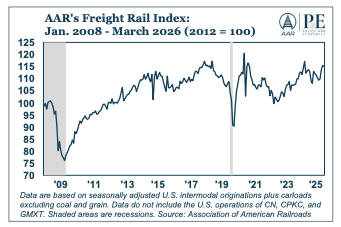
Weekly rail carload data from the Association of American Railroads shows the U.S. economy building momentum heading into spring, with March volumes excluding coal averaging 171,338 carloads per week — the strongest March since 2008 and the highest monthly level since August 2019. Chemical shipments set a record weekly average of 35,580 carloads, up 5.5 percent year over year, while grain volumes for the first quarter of 2026 reached their highest level since 1993, with March alone topping 97,000 carloads. Stripping out energy volatility, the data offers a cleaner read on industrial, agricultural, and consumer-linked freight, and current levels point to stabilization and renewed momentum. Conditions of this kind have historically preceded expansions rather than contractions.
AAR
April 8 2009: Somali pirates hijack Maersk Alabama ship
Exposing how lightly defended, high-value arteries of global commerce had become vulnerable to unconventional, non-state actors challenging free trade on the open seas. Coming after decades in which U.S. naval dominance underwrote “freedom of the seas,” the standoff and its aftermath marked an early crack in the post–World War II model of frictionless, American-guaranteed globalization, foreshadowing a more contested and securitized era of maritime trade.
Found a mistake? Have a news tip or feedback to share? Contact our newsroom using the button below:
citizen journal offers three flagship products: a daily national news summary, a daily Kansas news summary, and local news and school board summaries from 34 cities across 5 states. Use the links in the header to navigate to national, kansas, and local coverage. Subscribe to each, some, or all to get an email when new issues are published for FREE!
Brought to you by (click me!)
Sources
