Top 5 US news stories
March 4 2026


Israeli and U.S. Strikes Target Iran's Security Apparatus to Encourage Popular Revolt
Iranian Clerics Weigh Khamenei's Son as Supreme Leader Successor Amid Ongoing Strikes
Oil Tanker Traffic Through Strait of Hormuz Grinds to a Halt as Trump Pledges Naval Escorts
Senate Merges Bipartisan Housing Bills, Adds Trump-Backed Ban on Large Institutional Investors
Trump's Oil Blockade Devastates Cuba's Tourism Industry as Fuel Shortages Strand Visitors
Israeli and U.S. Strikes Target Iran's Security Apparatus to Encourage Popular Revolt
Israeli airstrikes are systematically targeting Iran's internal security infrastructure, including members of the Basij paramilitary force and senior intelligence officials, with the stated goal of dismantling the police state that killed thousands of antigovernment protesters in January. The United States has joined the campaign, striking domestic-security agencies including the Tehran headquarters of the Islamic Revolutionary Guard Corps, the powerful organization responsible for defending the regime. Israeli officials have concluded that weakening Iran's repressive apparatus from the air could clear the way for a popular uprising on the ground, marking a shift toward openly pursuing regime change. However, analysts caution that no clear historical precedent supports the theory that airstrikes alone can topple an entrenched authoritarian system. Ali Vaez, director of the Iran project at the International Crisis Group, warned that the strategy "ignores the resilience of entrenched authoritarian systems like the Islamic Republic."
WSJ
Iranian Clerics Weigh Khamenei's Son as Supreme Leader Successor Amid Ongoing Strikes
The Assembly of Experts, the senior clerical body responsible for selecting Iran's next supreme leader, met twice virtually on Tuesday to deliberate on a successor, with Mojtaba Khamenei, son of the slain Ayatollah Ali Khamenei, emerging as the clear front-runner, according to three Iranian officials familiar with the discussions. Some members expressed reservations about announcing the appointment as early as Wednesday morning, fearing it could expose the younger Khamenei as a target for the United States and Israel. Israel struck a building in Qom where the assembly had been scheduled to meet in person, though the building was empty at the time, according to Fars News. Vali Nasr, an expert on Iran at Johns Hopkins University, said the choice of Mojtaba Khamenei would suggest "a much more hard-line Revolutionary Guard side of the regime" is now in control.
NYT
Oil Tanker Traffic Through Strait of Hormuz Grinds to a Halt as Trump Pledges Naval Escorts
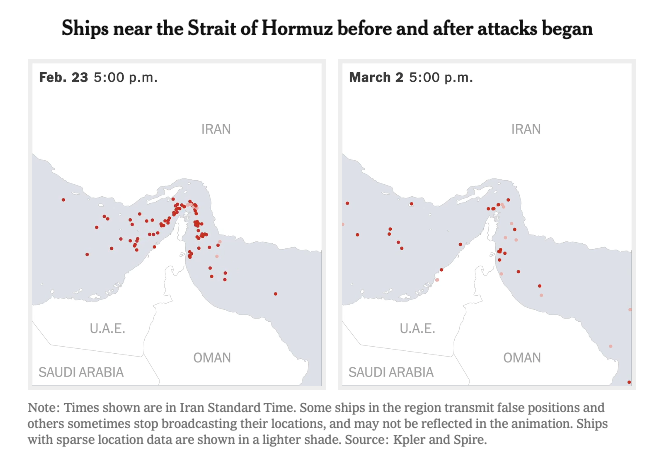
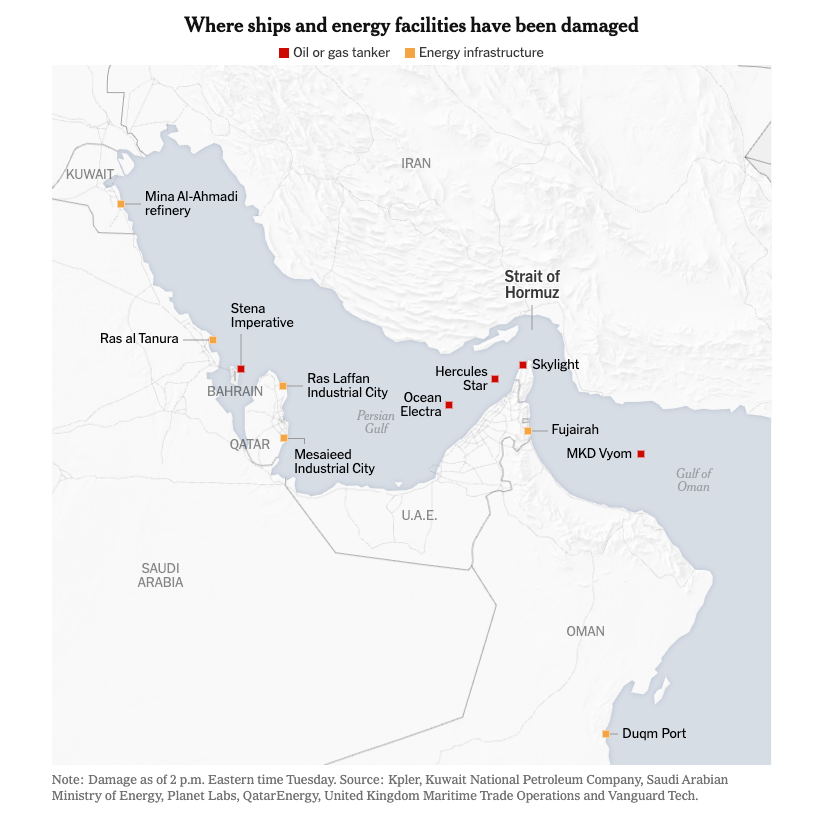
Oil and gas tanker traffic through the Strait of Hormuz, which typically sees around 80 vessels per day and carries a fifth of the world's oil supply, has dropped to near zero since U.S.-Israeli strikes on Iran began Saturday, with only three tankers crossing since Monday, according to a shipping analysis using data from industry firm Kpler. A senior Iranian military official threatened to "set on fire" any ships passing through the strait, and several vessels in the region have already come under attack. International oil prices have climbed 12 percent since hostilities began, trading around $81 a barrel Tuesday, while natural gas prices have surged in Europe and Asia.
In response, President Trump announced he had ordered the U.S. Development Finance Corporation to provide political risk insurance and guarantees for all maritime trade through the Gulf and said the U.S. Navy would begin escorting tankers through the Strait of Hormuz "as soon as possible." Dan Pickering, chief investment officer of Pickering Energy Partners, described the situation as "a de facto closure," noting significant numbers of vessels waiting on either side of the strait with no one willing to transit.
NYT / Truth Social
Senate Merges Bipartisan Housing Bills, Adds Trump-Backed Ban on Large Institutional Investors
The Senate Banking Committee released a combined version of bipartisan housing legislation, merging the Senate's ROAD to Housing Act with the House's Housing for the 21st Century Act, in what would represent a significant legislative achievement on affordability in a deeply divided Congress. The 21st Century ROAD to Housing Act aims to ease federal regulations that slow housing construction and encourage states and cities to reduce land-use restrictions, while notably adding a Trump-backed provision banning large institutional investors controlling more than 350 single-family homes from purchasing additional ones. The bill also includes a surprise temporary ban on central bank digital currencies through 2030, which Scott described as part of finding "the smoothest path to the finish line." The House already passed its version, the Housing for the 21st Century Act, by a 390-9 bipartisan vote on February 9, and the Senate took an initial procedural vote on the combined package this week with an 84-6 tally, with a final Senate floor vote expected this week. Once the Senate passes its version, the two chambers will need to reconcile differences in conference before sending a final bill to President Trump's desk.
Washington Examiner
Trump's Oil Blockade Devastates Cuba's Tourism Industry as Fuel Shortages Strand Visitors
The Trump administration's decision to block all foreign oil shipments to Cuba has brought the island's tourism industry, a critical pillar of its already collapsing economy, to its knees, as gasoline rationing, power outages, and dwindling jet fuel supplies forced Russian and Canadian airlines to suspend flights. Thousands of tourists were evacuated on empty jets sent to retrieve them, while stranded hotel employees were housed in blacked-out rooms, with electricity reserved only for guests. Cuba has long depended on sun-seeking Canadian visitors as a vital source of income, but the combination of Trump's travel restrictions and the oil blockade has intensified an economic crisis that observers say threatens the government's survival. Abandoned vehicles, apparently out of fuel, littered the roads to the airport as the last visitors departed.
NYT
March 4 1918: First cases reported in deadly 1918 flu pandemic
Army Private Albert Gitchell reported flu-like symptoms at Fort Riley, Kansas; within hours over 100 soldiers were ill, in what are believed to be the first reported U.S. cases of the 1918 influenza pandemic. This outbreak quickly spread through military camps, across the Atlantic with U.S. troops in World War I, and around the globe, ultimately infecting about 28% of Americans and killing tens of millions worldwide—far more than the war itself.
Found a mistake? Have a news tip or feedback to share? Contact our newsroom using the button below:
citizen journal offers three flagship products: a daily national news summary, a daily Kansas news summary, and local news and school board summaries from 34 cities across 5 states. Use the links in the header to navigate to national, kansas, and local coverage. Subscribe to each, some, or all to get an email when new issues are published for FREE!
Brought to you by (click me!)
Sources
- WSJ — Israel Is Blowing Up Iran's Police State to Clear the Way for a Revolt
- NYT — Iran: Mojtaba Khamenei Emerges as Successor
- NYT — Iran War: Oil and Gas in the Strait of Hormuz
- Truth Social — President Trump on Strait of Hormuz
- Washington Examiner — Combined Major Bipartisan Housing Bill
- NYT — Cuba Tourism Collapse
