Top 5 US news stories
March 3 2026

Iran Drone Strikes Force U.S. Embassy Closures Across the Middle East
Gulf Interceptor Supplies Dwindle in Race Against U.S.-Israeli Campaign to Destroy Iran's Launch Capability
Kuwait Port Strike Death Toll Doubles to Six as U.S. Recovers Remains of Additional Service Members
U.S. Military Campaigns in Iran and Venezuela Stand to Redraw Global Oil Map
Venezuela's Oil Exports Double Under U.S. Oversight as Production Recovers
Iran Drone Strikes Shutter U.S. Embassies in Saudi Arabia and Kuwait, Prompting Mass Evacuation Orders
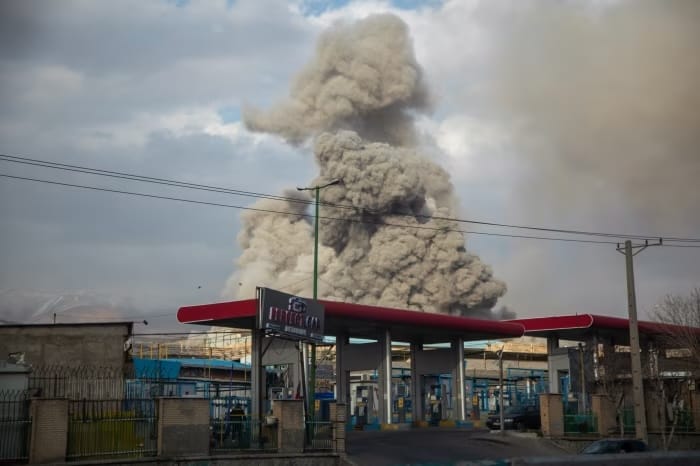
The State Department closed its embassies in Saudi Arabia and Kuwait on Tuesday after drone attacks struck both compounds, and urged Americans to depart immediately from 14 Middle Eastern countries as Iran expanded retaliatory strikes on U.S. targets in the widening regional conflict. The U.S. Embassy in Riyadh sustained minor damage after an attack by what appeared to be two drones, the Saudi Defense Ministry said Tuesday, while a drone attack the previous day caused a fire at the American Embassy compound in Kuwait, according to two U.S. officials who spoke on condition of anonymity because they were not authorized to discuss the matter publicly.
NYT
Gulf Interceptor Supplies Dwindle in Race Against U.S.-Israeli Campaign to Destroy Iran's Launch Capability
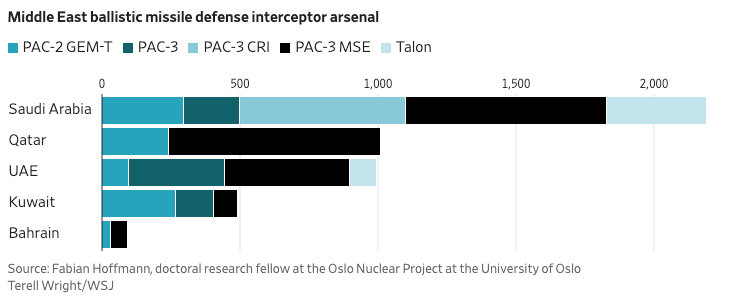
Persian Gulf nations targeted by Iran have so far managed to limit the damage by deploying sophisticated U.S.-made air defenses against the hundreds of drones and missiles that have rained on their cities. With costly interceptors and radar integrated with the U.S. military, the oil-rich Gulf Arab states have fielded some of the most advanced air defenses in the world, despite their small populations and militaries. The United Arab Emirates alone said that by Monday evening it had been targeted by 174 Iranian ballistic missiles, eight cruise missiles, and 689 drones in three days, with no missiles and 44 drones hitting the country. A crucial variable, however, is whether these monarchies start running out of interceptors before the Iranian regime runs out of projectiles. "The intensity of interceptor usage that we have seen over the last couple of days can't be maintained for more than another week — probably a couple of days at most, and then they will feel the pain of interceptor shortage," said Fabian Hoffmann, a missile expert at the University of Oslo. At current burn rates, the speed with which Israel and the U.S. manage to hunt down and destroy Iran's missile launchers and stockpiles — part of the air campaign launched Saturday morning — will determine whether the Gulf's defensive shield holds.
The strain on interceptor supplies has raised concerns that the prolonged conflict could force the redeployment of U.S. military assets from other theaters, including South Korea. President Trump predicted in a New York Times interview that the operation against Iran, named "Epic Fury," would last four to five weeks, but experts warn that if airstrikes extend beyond that window, air defense assets from U.S. Forces Korea — including Patriot and THAAD systems, as well as MQ-9 Reaper surveillance drones permanently stationed at Gunsan Air Base in South Korea — could be relocated to the Middle East. There is precedent: in June 2025, prior to the "Midnight Hammer" operation against Iranian nuclear facilities, the U.S. cyclically deployed three of eight USFK Patriot batteries to the region, returning over 500 personnel and equipment to South Korea by October. Experts and South Korean officials have cautioned that further redeployments could weaken the joint defense posture against North Korean ballistic missile threats, and the drawdown also raises questions about U.S. readiness for a potential Taiwan Strait contingency, as the same air defense and surveillance assets figure prominently in Pentagon planning for the Indo-Pacific theater.
WSJ / Chosun
Kuwait Port Strike Death Toll Doubles to Six as U.S. Recovers Remains of Additional Service Members
The death toll from an Iranian strike on a makeshift tactical operations center at the civilian Shuaiba port in Kuwait rose to six on Monday, after U.S. Central Command announced the recovery of two additional service members' remains — up from the three deaths initially reported Sunday. Defense Secretary Pete Hegseth said the strike penetrated a "fortified" center after "one" projectile made it through air defenses, in what sources described as a suspected drone attack that came with no warning sirens to alert personnel to evacuate or reach bunkers. A source familiar with the situation described the operations center as a triple-wide trailer with office space inside, with fire still smoldering hours later, its interior blackened and walls blown outward from the blast — marking the first U.S. combat deaths in the escalating conflict with Iran.
CNN
U.S. Military Campaigns in Iran and Venezuela Stand to Redraw Global Oil Map
Analysts are gaming out a scenario in which the U.S. and Israeli air campaign against Iran succeeds in producing a regime friendly — or at least not hostile — to Washington, a development that, combined with the recent ouster of Venezuelan President Nicolás Maduro, could neutralize two oil exporters that have been chronic sources of supply disruptions for generations and leave Russia as the sole adversarial oil power with diminished clout. While President Trump initially called for regime change in Iran, he may settle for less if an interim council now ruling the country meets his original conditions: an end to nuclear enrichment and ballistic missile development, and a halt to proxy support for groups like the Houthis and Hezbollah. An end to sanctions would only gradually boost Iranian production — from its current 3.2 million barrels per day to roughly 3.6 million by the end of next year, according to Rystad Energy — though Iran's proven reserves rank fourth in the world and the country once produced five to six million barrels daily before the 1979 revolution. Beyond new supply, the diminished threat of abrupt withdrawal from hostile regimes in both Iran and Venezuela would benefit global markets through reduced volatility and a lower geopolitical premium embedded in oil prices, though the direct economic benefit to the already net-petroleum-exporting United States would likely be slight compared to the enormous geopolitical gain.
WSJ
Venezuela's Oil Exports Double in February as Production Recovers Under U.S.-Directed Oversight
Venezuela sharply increased its oil exports in February, sending roughly twice as many barrels abroad compared with the previous month, as daily exports measured by vessel loadings rose to a five-month high of 788,000 barrels — up from approximately 383,000 in January — according to shipping reports and data from maritime intelligence firm Kpler Ltd. Crude production is recovering after slumping to roughly a two-year low in January, when the capture of Nicolás Maduro by U.S. Special Forces threw the country into uncertainty.
Bloomberg
March 3 1820: Congress passes the Missouri Compromise
The Missouri Compromise of 1820 let Missouri enter the Union as a slave state and Maine as a free state while banning slavery in most of the remaining Louisiana Purchase north of the 36°30′ line, temporarily preserving the balance of power between North and South. Over time, Southern leaders chafed at these limits, and Congress’s 1854 Kansas-Nebraska Act repealed the compromise by allowing settlers in Kansas and Nebraska to decide slavery by popular sovereignty, directly triggering the violent clashes known as “Bleeding Kansas.” The breakdown of this earlier compromise system, the bloodshed in Kansas, and the hardening of pro- and antislavery positions helped push the nation past the point of political compromise and into the Civil War in 1861.
Found a mistake? Have a news tip or feedback to share? Contact our newsroom using the button below:
citizen journal offers three flagship products: a daily national news summary, a daily Kansas news summary, and local news and school board summaries from 34 cities across 5 states. Use the links in the header to navigate to national, kansas, and local coverage. Subscribe to each, some, or all to get an email when new issues are published for FREE!
Brought to you by (click me!)
Sources
- NYT — Iran War Live Updates
- WSJ — Gulf States Race Against Time
- Chosun — USFK Assets and Middle East Deployment
- CNN — Six Soldiers Killed in Iranian Strike
- WSJ — Iran Success as Oil Game Changer
- Bloomberg — Venezuela Crude Exports Double
