Top 6 US news stories
February 24 2026


Trump Plans State of the Union Push on Economy as Republican Midterm Fears Mount
Mixed Signals Define U.S. Economy After Trump's First Year as Hiring Slows but Unemployment Holds Steady
Viral AI Report Fuels 800-Point Dow Plunge as Tech-Heavy Market Rattles Over White-Collar Job Threat
Apple Moves Mac Mini Production to Houston Amid Trump Administration Tariff Pressure
Anthropic's AI-Powered COBOL Modernization Tool Triggers IBM's Worst Stock Drop in 25 Years
Meta Strikes $100 Billion AMD Chip Deal as U.S. Struggles to Wean Tech Industry Off Taiwan
Trump Plans State of the Union Push on Economy as Republican Midterm Fears Mount
WASHINGTON — President Trump will use his State of the Union address to sell the public on the economy and unveil new cost-lowering measures, as Republicans scramble to address voter anxiety over affordability ahead of November's midterm elections. The speech, themed "America at 250: Strong, Prosperous and Respected," is expected to highlight tax cuts, prescription drug pricing efforts, and a healthcare framework the president wants Congress to codify — though Republican lawmakers have shown little appetite for taking up the legislation in an election year. The address comes as polling shows broad voter dissatisfaction with the economy, a warning sign both parties acknowledge could translate into Republican losses this fall. Virginia Gov. Abigail Spanberger will deliver the official Democratic response, while several Democratic members plan to skip the speech entirely in favor of counter-rallies in Washington.
WSJ
Mixed Signals Define U.S. Economy After Trump's First Year as Hiring Slows but Unemployment Holds Steady
Jobs
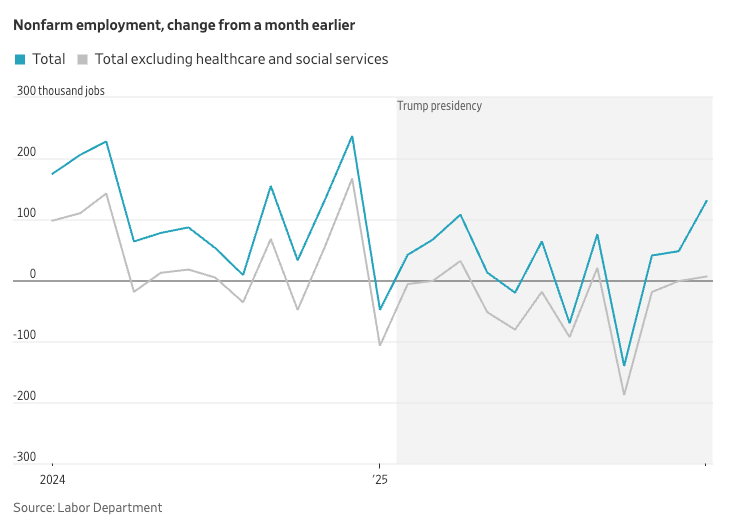
U.S. employers added just 181,000 jobs in 2025, the lowest non-recession figure in more than two decades, as economic and trade uncertainty dampened hiring and some tech companies reversed their post-pandemic workforce expansion. Trump's immigration crackdown further reduced the pool of available foreign workers.
Unemployment
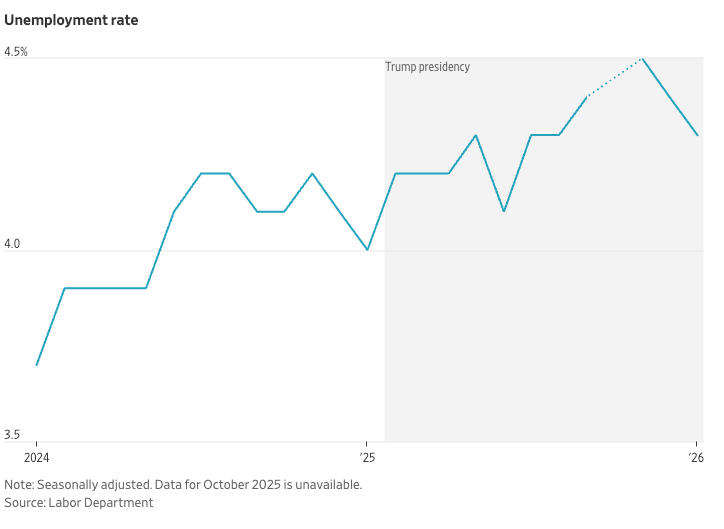
Despite the sharp hiring slowdown, the unemployment rate remained historically low, topping out at 4.5% in November before settling at 4.3% last month — a departure from the typical pattern in which falling job creation drives unemployment higher.
Inflation
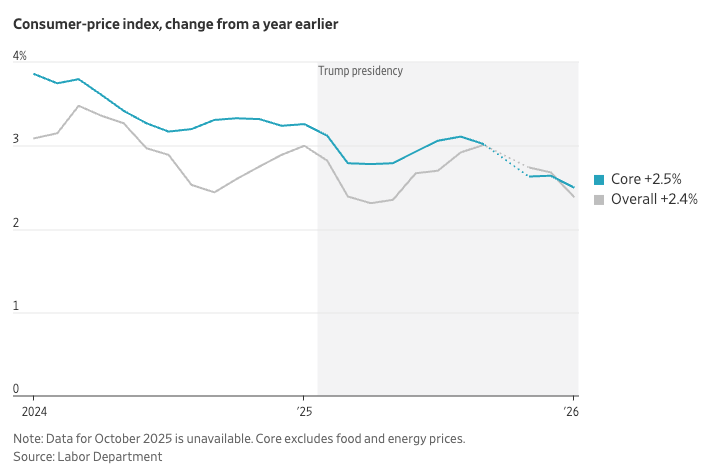
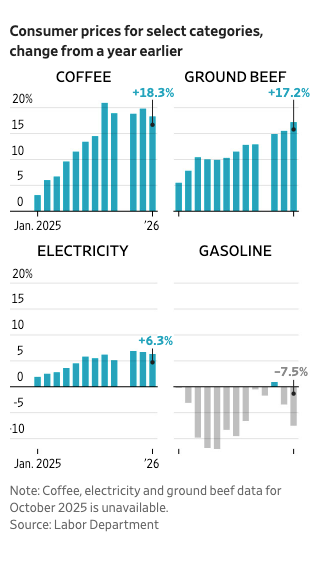
Trump's tariffs and trade wars did not trigger the inflation surge many economists predicted; the annual rate stood at 2.4% last month, down from 3% in January 2025. Americans remain burdened by prices well above pre-pandemic levels, particularly for coffee and ground beef, though gasoline prices have offered some relief.
Wages
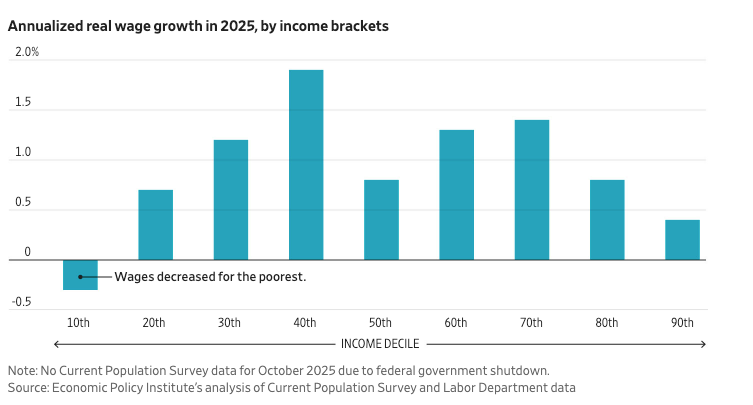
Real wages rose slightly faster in the 12 months ending in January than in the prior year, helping sustain consumer spending. However, Americans with the lowest incomes saw real wages fall in 2025, according to a study from the Economic Policy Institute — a phenomenon economists describe as a K-shaped economy in which wealthier households surge ahead while the poorest fall behind.
Trade Deficit
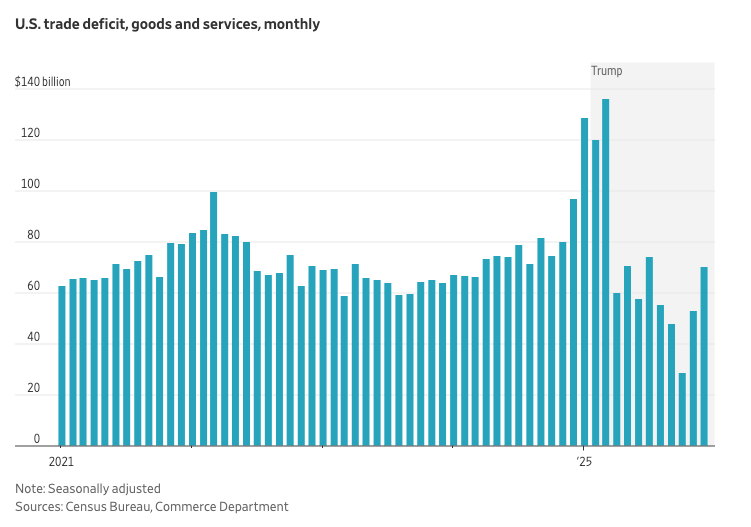
The monthly trade deficit surged to record levels in early 2025 as companies rushed to stockpile imported goods ahead of anticipated tariffs, but fell to a sustained lower level after the levies took effect — settling back near pre-2025 norms through the end of the year.
Manufacturing
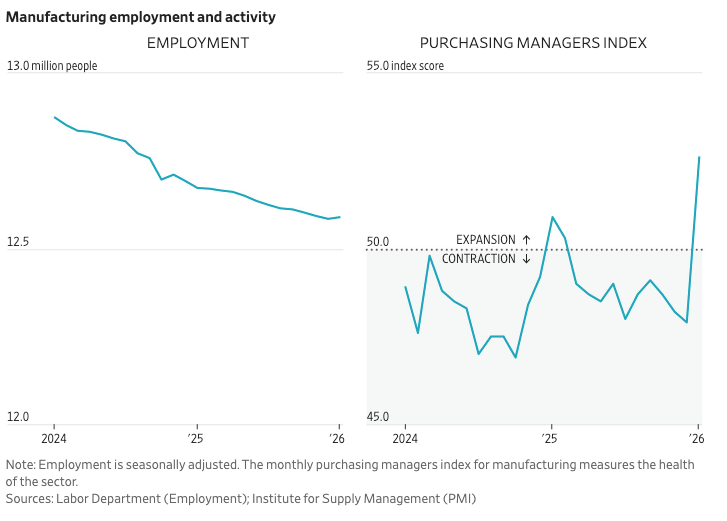
Manufacturing employment declined over eight consecutive months amid uncertainty tied in part to sweeping global tariffs, which raised production costs for companies reliant on global supply chains. Production itself, however, rose 2.6% on the year, and a closely watched factory-activity index showed expansion for the first time since February 2025.
Housing Affordability
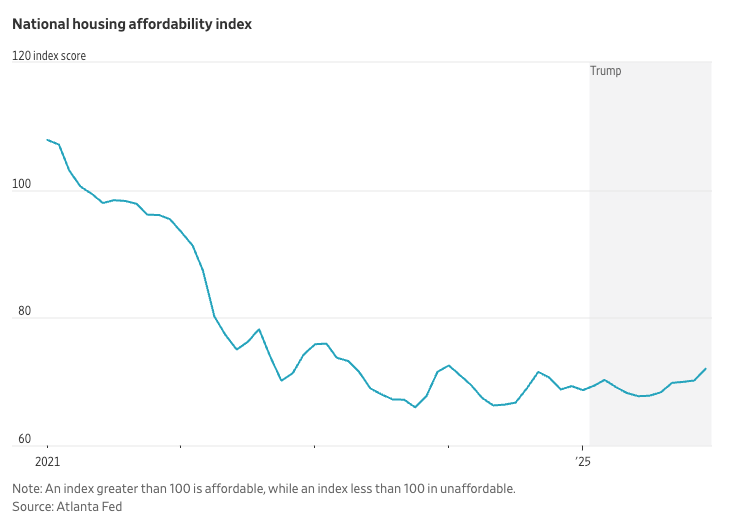
A median-income household seeking a median-price home must now devote 42% of its monthly earnings to mortgage payments, taxes, and insurance — slightly improved from 44% in January 2025 but still elevated. Mortgage rates remain far above early-2022 levels, home prices have held firm, and rents, while easing in some Sunbelt cities, remain well above pre-pandemic norms.
WSJ
Viral AI Report Fuels 800-Point Dow Plunge as Tech-Heavy Market Rattles Over White-Collar Job Threat
A 7,000-word hypothetical scenario published by Citrini Research helped fuel an 800-point drop in the Dow Jones Industrial Average on Monday, underscoring just how sensitive a tech-heavy, AI-anxious market has become. The viral report, framed as a fictional dispatch from June 2028 rather than a prediction, painted a scenario in which rapidly advancing AI tools enable sweeping white-collar workforce reductions, triggering mass unemployment and financial contagion — a thesis its author called "the global intelligence crisis." Monday's market moves broadly tracked the report's logic, as investors grappled with a provocative new question: whether AI could prove so economically productive that its disruption of knowledge work becomes a net drag on markets.
WSJ
Apple Moves Mac Mini Production to Houston Amid Trump Administration Tariff Pressure
Apple will begin manufacturing its Mac Mini desktop computer at a Foxconn facility in north Houston later this year, shifting production from Asia in its latest effort to reshore portions of its vast supply chain. The move, confirmed by Apple Chief Operating Officer Sabih Khan during the facility's first public tour, is part of the company's pledge last August to invest $600 billion in the U.S. over four years — a commitment made under pressure from the Trump administration, which has offered tariff exemptions to companies that expand domestic production. The Houston facility, which currently assembles Apple's AI servers, will convert 220,000 square feet of warehouse space to Mac Mini manufacturing.
WSJ
Anthropic's AI-Powered COBOL Modernization Tool Triggers IBM's Worst Stock Drop in 25 Years
Shares of International Business Machines plunged 13% on Monday — the stock's worst single-day decline since October 2000 — after Anthropic published a blog post detailing how its AI tools can help modernize COBOL, the legacy programming language created in 1959 that still underpins critical systems at major banks, government agencies, and airlines running on IBM mainframes. The selloff reflects mounting investor anxiety over the threat AI poses to established software business models; IBM's stock has fallen 27% so far in February, putting it on pace for its worst month since at least 1972, according to Dow Jones Market Data.
WSJ
Meta Strikes $100 Billion AMD Chip Deal as U.S. Struggles to Wean Tech Industry Off Taiwan
Meta Platforms has agreed to purchase 6 gigawatts' worth of AI computing power from Advanced Micro Devices in a deal valued at more than $100 billion, representing a major win for AMD in its bid to challenge Nvidia's dominance in the GPU market. Under the five-year agreement, Meta will deploy AMD's latest MI450 series chips to power data centers, with the first gigawatt expected online later this year. The deal includes warrants allowing Meta to acquire up to 160 million AMD shares — roughly 10% of the company — at $0.01 per share, contingent on performance milestones including AMD's stock reaching $600, well above its Monday close of $196.60.
The deal's scale underscores how aggressively U.S. tech companies are building out AI infrastructure even as the federal government has struggled for years to reduce the industry's dependence on Taiwan for advanced chip manufacturing. Notably, both AMD and its rival Nvidia are fabless companies — they design chips but outsource manufacturing to Taiwan Semiconductor Manufacturing Co. (TSMC) on the island. The Meta-AMD deal, while shifting market share between GPU suppliers, does nothing to lessen the concentration of advanced chip production in Taiwan. In classified briefings, national security officials have warned executives from Apple, AMD, and Qualcomm that a Chinese blockade of Taiwan — which produces roughly 90% of the world's most advanced semiconductors — could cripple the U.S. technology sector. Despite billions in Biden-era subsidies and Trump-era tariff threats aimed at boosting domestic production, the industry has largely refused to shift its sourcing away from the island.
For context, 6 gigawatts of computing power is roughly equivalent to the electricity consumption of 4.5 to 5 million American homes, or enough to power a metropolitan area the size of Houston.
WSJ / NYT
February 24 1803: Marbury v. Madison establishes judicial review
Marbury v. Madison is important because it gave the Supreme Court the power to say when a law violates the Constitution. This power, called judicial review, means even Congress and the President can be checked if they overstep their authority. It helps protect people’s rights by making sure the government follows the Constitution as the highest law of the land.
Found a mistake? Have a news tip or feedback to share? Contact our newsroom using the button below:
citizen journal offers three flagship products: a daily national news summary, a daily Kansas news summary, and local news and school board summaries from 34 cities across 5 states. Use the links in the header to navigate to national, kansas, and local coverage. Subscribe to each, some, or all to get an email when new issues are published for FREE!
Brought to you by (click me!)
Sources
- WSJ — Trump State of the Union
- WSJ — U.S. Economy in Trump's First Year
- WSJ — Stock Market / Citrini AI Report
- Citrini Research — 2028 Global Intelligence Crisis Report
- WSJ — Apple Mac Mini Houston Manufacturing
- WSJ — IBM Stock Decline on AI Threat
- WSJ — Meta and AMD $100B AI Chip Deal
- NYT — Taiwan, China, and Silicon Valley Chip Dependence
