Top 5 US news stories
February 20 2026

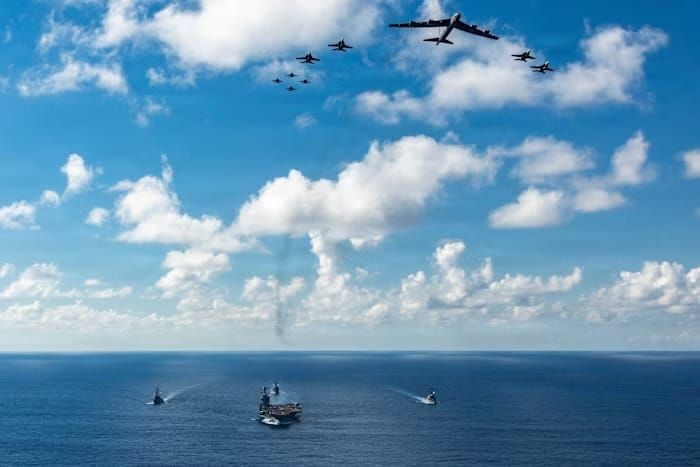
Trump Weighs Limited Strike on Iran to Force Nuclear Deal as U.S. Amasses Largest Middle East Air Power Since 2003
Fractured Iranian Opposition Leaves U.S. With No Clear Post-Regime Plan
Starbucks Bets on Afternoon Sales to Reignite Stagnant Stock
Amazon Overtakes Walmart as America's Largest Company by Revenue
Dershowitz Mounts Supreme Court Challenge to Landmark Press Freedom Ruling
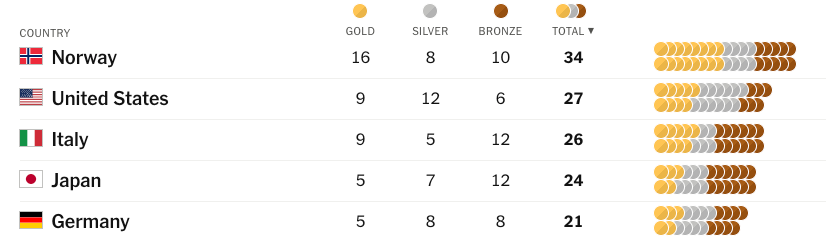
2026 Winter Olympics medal count
Trump Weighs Limited Strike on Iran to Force Nuclear Deal as U.S. Amasses Largest Middle East Air Power Since 2003
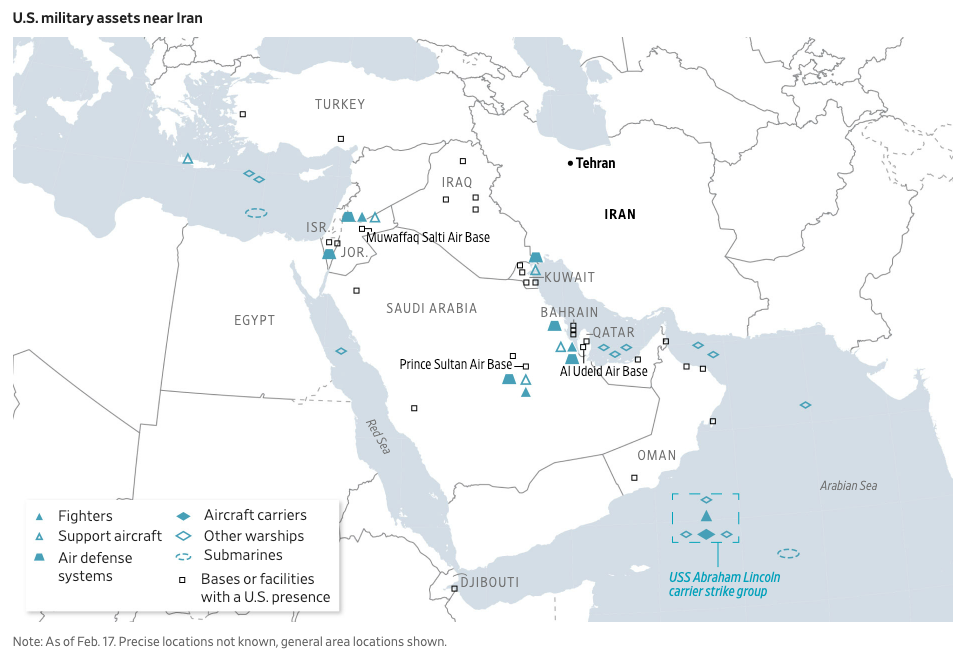
The Wall Street Journal reports that President Trump is considering an initial limited military strike on Iran targeting a small number of military or government sites to pressure Tehran into accepting his demands for a nuclear deal, with a broader campaign against regime facilities—potentially aimed at toppling the government—planned if Iran refuses to end its nuclear enrichment, according to people familiar with the matter. The opening assault, which could come within days, coincides with a massive U.S. military buildup across the Middle East, including the deployment of scores of combat aircraft—among them stealth F-22s, F-35s, and EA-18G jamming aircraft—to bases in Jordan, Saudi Arabia, and elsewhere, with a second aircraft carrier soon to be within striking range. Saudi Arabia and the United Arab Emirates have declined to allow U.S. aircraft to use their airspace for strikes on Iran, forcing many fighters to operate from more distant Jordanian bases and rely more heavily on aerial refueling, while long-range B-2 stealth bombers could launch nonstop missions from the continental United States with tanker support, as they did when Trump ordered strikes on Iran's nuclear sites in June 2025.
Editor's note: This administration has had few serious leaks. The sourcing ("people familiar with the matter") suggests a deliberate plant—likely a signal aimed at Tehran, Congress, or both, not a window into secret deliberations.
WSJ
Fractured Iranian Opposition Leaves U.S. With No Clear Post-Regime Plan
President Trump faces an unusually difficult risk assessment as he weighs military strikes against Iran: there is no clear alternative leader or unified opposition movement that would emerge if Supreme Leader Ali Khamenei's regime collapses, leaving U.S. officials to acknowledge they would have to hope to find cooperative figures through a complex transition. Iranian opposition to the Islamic Republic is politically fractured, disorganized, and physically divided between those at home and abroad, a stark contrast to the 1979 revolution when Iranians across social classes united under Ayatollah Ruhollah Khomeini, who could draw on a vast network of mosques and charitable organizations to coordinate popular mobilization. Secretary of State Marco Rubio has acknowledged the challenge before Congress, while former Islamic Republic official turned opposition activist Mohsen Sazegara has warned that killing Khamenei and top commanders without a succession plan could leave Iran a failed state—and no comparable opposition figure exists today to fill the void.
WSJ
Starbucks Bets on Afternoon Sales to Reignite Stagnant Stock
Starbucks is attempting to solve a fundamental economic imbalance at its U.S. stores, where more than half of company-operated sales—roughly $12 billion annually—occur before 11 a.m., leaving baristas on the clock through slower afternoon and evening hours with significantly less customer traffic. Chief Executive Brian Niccol sees making those post-lunch hours as productive as the morning surge as the key to improving unit economics and reviving a stock that has stagnated for nearly five years, and investors are encouraged by early results: shares are up 14% this year on the company's strongest U.S. same-store growth in two years, with Starbucks projecting revenue growth of 5% or more by its 2028 fiscal year.
WSJ
Amazon Overtakes Walmart as America's Largest Company by Revenue
Amazon has surpassed Walmart as the largest U.S. company by annual revenue, posting $716.9 billion in sales for its most recent full year compared with Walmart's $713.2 billion for the year through January 31—ending Walmart's nearly two-decade reign as the nation's top-grossing company. The milestone underscores the diverging growth trajectories of the two retail giants: Amazon's sales grew 12.4% last year while Walmart clocked 4.7% growth, reflecting the 31-year-old company's rapid expansion from an online bookseller started in Jeff Bezos' garage into a behemoth spanning cloud computing, artificial intelligence, entertainment, and e-commerce. Former Walmart U.S. CEO Bill Simon characterized the shift by saying Walmart went from "driving the bus" to "riding the bus," as Amazon's ascent forced the 63-year-old retailer to fundamentally reshape its own business model.
WSJ
Dershowitz Mounts Supreme Court Challenge to Landmark Press Freedom Ruling
Alan Dershowitz has petitioned the Supreme Court to overturn New York Times Co. v. Sullivan, the landmark 1964 ruling that requires public figures to prove "actual malice"—knowledge of falsity or reckless disregard for the truth—to win a defamation case. Dershowitz, who has represented O.J. Simpson, Jeffrey Epstein, and President Trump, argues the decision "has outlived any claim to validity it might once have had" and says he would have won his libel suit against CNN, which he claims mischaracterized his defense of Trump during an impeachment trial, but for the Sullivan standard. The challenge carries an unusual irony: Dershowitz served as a Supreme Court clerk the year Sullivan was decided and now seeks to dismantle the precedent he witnessed being created. Critics of the standard say it is outdated in the modern media landscape; defenders call it essential to preventing powerful figures from using libel suits to silence journalism.
NYT
February 20 1962: John Glenn becomes first American to orbit Earth
During the early 1960s, the United States and the Soviet Union were locked in the Cold War, a global struggle between American-led capitalism and democracy and Soviet-led communism, with each side racing for military, nuclear, and technological superiority. The USSR’s early spaceflight successes—like Yuri Gagarin’s 1961 orbit and Gherman Titov’s multi-orbit mission—made the U.S. appear technologically inferior, intensifying pressure on NASA to match and surpass Soviet achievements in space.
Found a mistake? Have a news tip or feedback to share? Contact our newsroom using the button below:
citizen journal offers three flagship products: a daily national news summary, a daily Kansas news summary, and local news and school board summaries from 34 cities across 5 states. Use the links in the header to navigate to national, kansas, and local coverage. Subscribe to each, some, or all to get an email when new issues are published for FREE!
Brought to you by (click me!)
Sources
- WSJ — Trump Weighs Strike on Iran
- WSJ — U.S. Military Buildup in Middle East
- WSJ — Iran Regime Replacement Options
- WSJ — Starbucks Afternoon Sales Push
- WSJ — Amazon Surpasses Walmart
- NYT — Dershowitz v. Sullivan Challenge
