Top 6 Kansas news stories
February 4 2026

Kansas Constitutional Amendment Would Allow Governor Election Without Statewide Popular Vote Majority
State Legislators Advance Child Protection Bills Requiring Parental Consent for Minors' Social Media Accounts
Panasonic Expands De Soto Battery Production to 50% Capacity Despite Industry Headwinds
New Legislation Would Exempt Data Centers From Traditional Utility Oversight
Kansas Lawmakers Tighten Election Security Requirements Targeting Voter Rolls and Ballot Counting
Bipartisan Coalition Introduces Legislation to Expand Free School Meals for Kansas Students
Kansas Constitutional Amendment Would Allow Governor Election Without Statewide Popular Vote Majority
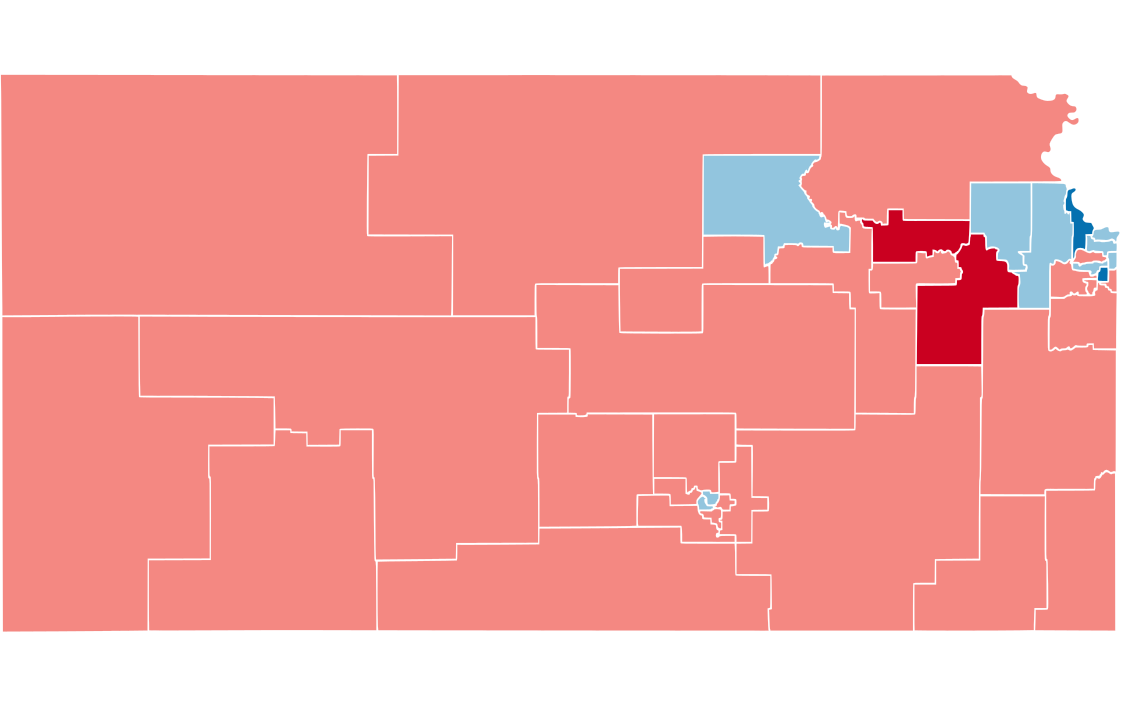
TOPEKA, Kan. — Kansas House lawmakers introduced a constitutional amendment Tuesday that would create an unprecedented state-level electoral college system for electing the governor, a proposal supporters say would balance urban and rural representation but critics argue could allow candidates to win without the most votes statewide. House Concurrent Resolution 5027, introduced by the House Elections Committee chaired by Rep. Pat Proctor, R-Leavenworth, would allocate one elector to each of the state's 40 senate districts, with the candidate pair receiving votes from at least 21 districts winning the governorship. If no ticket secures a majority, the Republican-controlled Legislature would decide the outcome in a joint session. The amendment's ballot language explicitly states it would "ensure a balanced representation of urban and rural areas." The proposal emerges as Kansas's population increasingly concentrates in its eastern urban counties. Johnson County alone holds more than 630,000 residents — roughly eight times the population of an average senate district — while rural western Kansas contains numerous districts with far fewer voters but equal electoral weight under the proposed system. Democratic Gov. Laura Kelly, who is term-limited and serving her final year, won statewide in 2018 and 2022 under the current popular vote system despite Republicans holding supermajorities in both legislative chambers.
 Greg Loving
State Legislators Advance Child Protection Bills Requiring Parental Consent for Minors' Social Media Accounts
TOPEKA, Kan. — Kansas legislators introduced a bill Tuesday that would prohibit social media platforms from allowing children under 16 to create accounts without verified parental consent, which parents could revoke at any time. House Bill 2657, introduced by the Legislative Modernization Committee, would require platforms to implement age-verification measures and suspend access to existing accounts until parental consent is obtained. Parents could also request deletion of a minor's account. The attorney general would enforce the measure under the Kansas Consumer Protection Act. A companion bill, HB 2671 — the "Kansas Community Harmed by AI Technology Act" — would impose similar restrictions on artificial intelligence chatbots, requiring companies to verify user ages, obtain parental consent for minors and block interactions involving suicidal ideation or sexually explicit content. The Education Committee's HB 2662 would require schools to designate a "student safety and awareness month" featuring programs on fentanyl dangers, personal safety and social media literacy. Lawmakers also advanced measures addressing children in state custody. HB 2638, from the Child Welfare and Foster Care Committee, would require the secretary for children and families to formally notify children of their rights, maintain records of that notification and obtain written confirmation of comprehension. The Judiciary Committee introduced HB 2651, which would allow voluntary paternity acknowledgments to be challenged at any time in cases of fraud, duress or mistake of fact — including when genetic testing contradicts the acknowledgment.
 Greg Loving
Panasonic Expands De Soto Battery Production to 50% Capacity Despite Industry Headwinds
TOPEKA, Kan. — Panasonic's Kansas battery plant will ramp up to 50% of its production capacity in the next few months, a company executive said Monday, as the facility continues expansion despite challenges facing the electric vehicle industry. Kristen Walters, Panasonic Energy vice president of human resources, said the company is starting two new production lines at its De Soto plant, adding to two lines already in operation. Construction has begun on the second wing of the lithium-ion battery cell plant, and two of the wing's four lines will be in operation in 2027, Walters said in a virtual interview. The plant opened in July amidst concerns political changes would affect operations. The Trump administration eliminated tax credits for buying electric vehicles, which dropped the industry's sales at the end of last year in the fourth quarter by 36%, year over year, according to Cox Automotive. Walters said Panasonic Energy has added battery customers in addition to Tesla, which is its largest customer. The company is projected to employ 4,000 people once it reaches full capacity and currently employs approximately 1,400 workers.
Kansas Reflector
New Legislation Would Exempt Data Centers From Traditional Utility Oversight
TOPEKA, Kan. — A group of House Republicans introduced legislation Tuesday that would allow private industrial facilities and data centers to generate and purchase electricity outside traditional utility regulation, a move supporters say will attract major technology investments to Kansas. House Bill 2664, the "Private Energy Campus and Industrial Host Site Generation Act," was introduced by Reps. Neelly, Buehler, T. Johnson and Proctor. The bill would authorize electricity sales to private enterprises on designated campuses without public utility oversight and would exempt such operations from parallel generation and net metering requirements. The legislation comes as states compete aggressively for data center development, which requires massive amounts of reliable electricity. Utility companies could enter interconnection agreements with private campuses under the bill. Critics may raise concerns about grid reliability and whether large industrial users should be exempt from regulations that apply to other customers.
Citizen Journal
Kansas Lawmakers Tighten Election Security Requirements Targeting Voter Rolls and Ballot Counting
TOPEKA, Kan. — Kansas lawmakers introduced legislation Tuesday that would tighten election procedures on multiple fronts, continuing a conservative push on election security that has defined recent legislative sessions. House Bill 2640, introduced by the Elections Committee, would require the secretary of state to periodically compare the state's voter registration rolls against the federal Systematic Alien Verification for Entitlements database, known as SAVE, which is used to verify immigration status. The secretary would be required to report annually to the Legislature on the results. The bill reflects ongoing Republican concerns about noncitizen voting, though studies have consistently found such cases to be exceedingly rare. Rep. Samantha Poetter Parshall, R-Paola, introduced HB 2659, which would require all election audits and recounts to be conducted using hand counts of paper ballots rather than machine tabulation. The measure responds to distrust of electronic voting equipment that has persisted among some conservatives since the 2020 presidential election. On the campaign finance side, the Senate Federal and State Affairs Committee introduced SB 451, which would require campaign treasurers to disclose the specific products and services provided by vendors when campaigns pay advertising agencies, public relations firms or political consultants — closing what sponsors view as a transparency gap that allows campaigns to obscure how money is actually spent.
 Greg Loving
Bipartisan Coalition Introduces Legislation to Expand Free School Meals for Kansas Students
TOPEKA, Kan. — House lawmakers introduced two separate bills Tuesday aimed at expanding free meal access for Kansas students, with proposals ranging from encouraging federal program participation to creating a state-funded universal meals initiative. House Bill 2637, sponsored by Reps. Essex, Bohi, Esau, Stiens and L. Williams, would require eligible school boards to consider participating in the federal Community Eligibility Provision, which allows high-poverty schools to serve free meals to all students. The bill includes a financial hardship exception and directs the state education department to assist districts seeking participation. A more ambitious proposal, HB 2656, would establish the "No Kid Hungry in Schools" program, reimbursing districts for the cost of providing meals to all students. That bill is sponsored by Rep. Wikle and 16 co-sponsors including Reps. Boatman, Carr, Featherston, Haskins, Hoye, Martinez, Melton, Meyer, Ohaebosim, Oropeza, Osman, Poskin, Simmons, Vaughn, Woodard and Xu — a coalition that includes both Republicans and Democrats concerned about childhood hunger.
Citizen Journal
Sources
Found a mistake? Have a news tip or feedback to share? Contact our newsroom using the button below:
citizen journal offers three flagship products: a daily national news summary, a daily Kansas news summary, and local news and school board summaries from 20 cities across Kansas. Each issue contains 5 paragraph-length stories that are made to be read in 5 minutes. Use the links in the header to navigate to national, kansas, and local coverage. Subscribe to each, some, or all to get an email when new issues are published for FREE!
Brought to you by (click me!)
