LOVING: For Hamilton to win, a lot of Republicans have to cross over
The polls say he's ahead. The voter rolls say something else. The last 3 statewide races tell you how to think about this.



Sign up for our free newsletter and never miss a story.
Sign up freeThis week's CJ+ column is unlocked. Subscribe to get weekly columns.
If you only read the polls, the Kansas Senate race is over. Emerson's final survey has Adam Hamilton up 49-45 on Roger Marshall.
CNN has it 49-45. YouGov had it 48-45. No public poll has shown Marshall ahead since mid-October.
If you only read the voter rolls, it also isn't close. Kansas has 849,808 registered Republicans, 486,313 registered Democrats and 529,248 unaffiliated voters.
That's 45%, 26% and 28%. Republicans outnumber Democrats nearly 2 to 1.
The two can both be right only if a lot of registered Republicans vote for Hamilton. This column sizes how many, checks that number against what Kansas actually did in 2014, 2018, 2020 and 2022, and reads the early vote with that in mind.
The arithmetic
Hamilton's path has 3 parts: hold Democrats, win unaffiliated voters big, and peel off Republicans. The first 2 are close to maxed out.
Emerson has him at 59-25 with independents. The third part decides the race.
Assume he holds 9 in 10 Democrats and wins unaffiliated voters 2 to 1. If Election Day turnout mirrors the rolls, Hamilton needs roughly 1 in 6 Republicans.
CNN's final poll has him converting about 12% of Republicans and Republican-leaning voters, or 1 in 8.
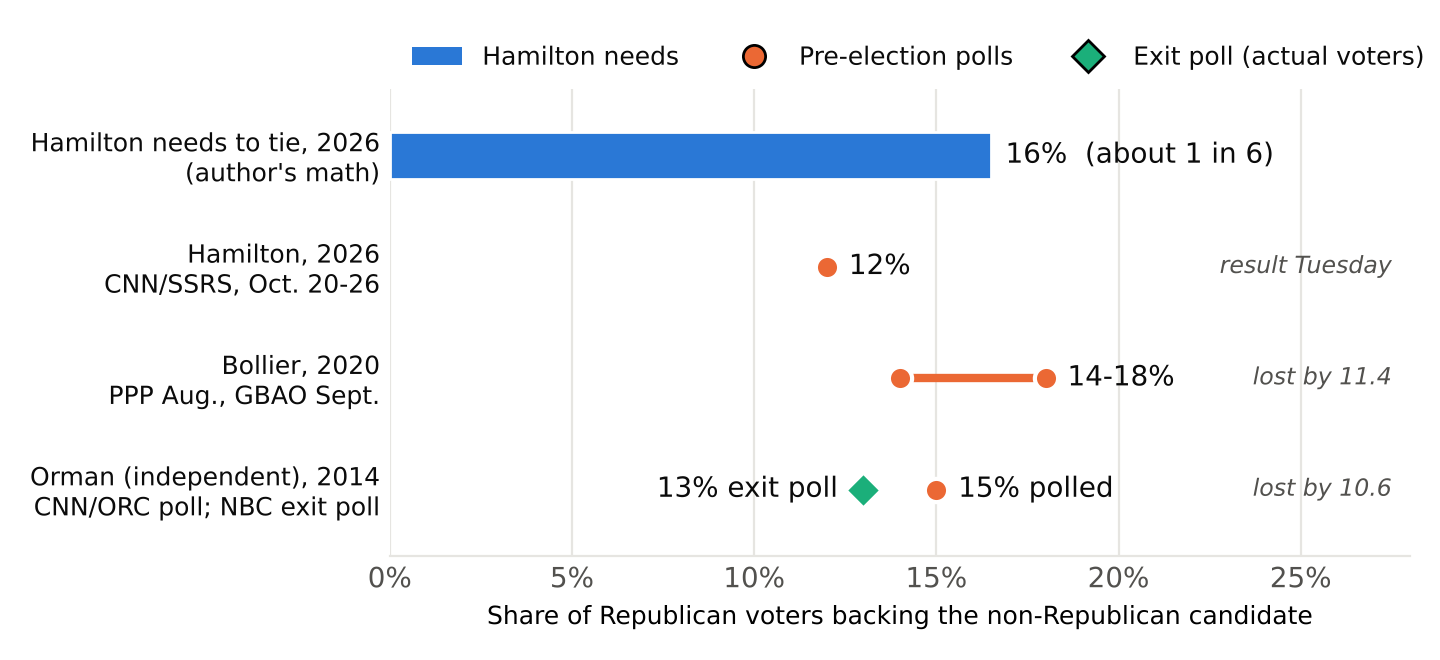
Figure 1: Republican crossover Hamilton needs to beat Marshall, against the crossover measured for non-Republican candidates in prior Kansas Senate races. 2014 is the only race with an exit poll; 2020 figures are pre-election polls. Author's math assumes Hamilton holds 90% of Democrats and wins unaffiliated voters 2 to 1.
2022 and 2020
Kansas Republicans do cross over. On Nov. 8, 2022, the same voters gave Laura Kelly a 49.5-47.3 win and Jerry Moran a 60-37 win.
Emerson's final poll had Kelly converting 18% of Republicans and 49% of independents, and it was right: she polled +3 and won by 2.
Those same voters did not cross over in the Senate race on the same ballot. Moran took 60%. Mark Holland, the Democrat, got 37%, about 12 points below Kelly.
About 128,000 Kansans voted for Kelly for governor and Moran for Senate on the same day. Kansas Republicans will vote for a Democrat. They vote for a particular Democrat, not for the party.
In 2020, Barbara Bollier, a former Republican state senator with a heavily funded campaign, polled at converting 14% to 18% of Republicans.
Public polls had the race inside 4 points through October. Marshall won by 11.4. The Republicans who told pollsters they'd cross over mostly didn't, or came home in the last week.
Kelly also won in 2018, beating Kris Kobach 48-43, with independent Greg Orman taking 6.5%. Hamilton is polling where Kelly polled. He is also polling where Bollier polled.
The polls were right about one and wrong about the other.
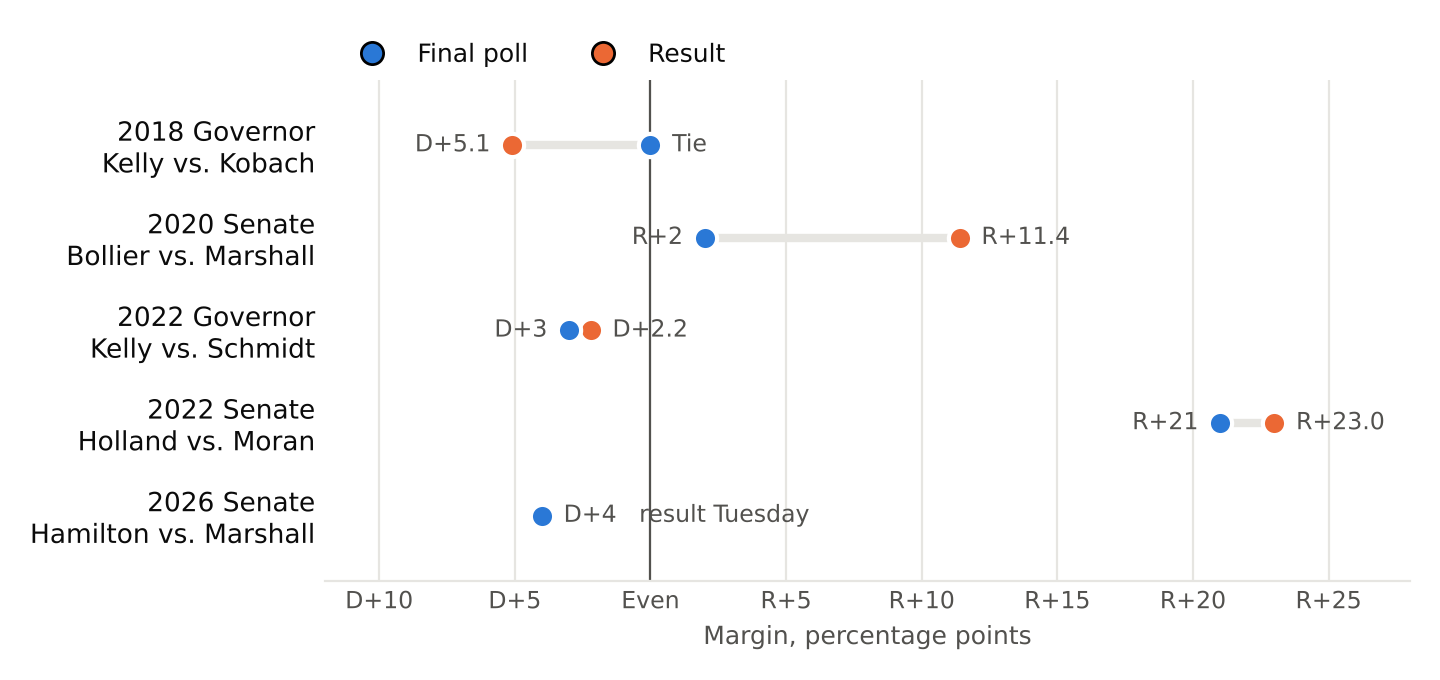
Figure 2: Final public poll margin vs. certified result, Kansas statewide races 2018-2022, with the final Emerson poll of the 2026 Senate race. Polls: PPP 2018; public average 2020; Emerson 2022 and 2026. Results: Kansas Secretary of State.
The early vote
Kansas is about to pass its 2022 advance-vote total. Through Friday, 375,937 Kansans had voted early.
The entire 2022 midterm produced 386,729 advance ballots, and voting runs through noon Monday, Nov. 2.
Who is voting early has changed more than how many. In 2022, Republicans cast 49% of advance ballots and Democrats 38%, an 11-point Republican edge.
This year the two parties are even: Republicans 43.0%, Democrats 42.2%. Democrats held the lead for 2 weeks and lost it Friday. Unaffiliated voters are 28% of the rolls and 14.8% of ballots cast.
Democrats front-loaded their vote: one in 3 registered Democrats in Kansas has already voted. For Republicans it's 1 in 5.
Democratic enthusiasm was real and it showed up early, but it came out of a pool half the size. What remains for Democrats is a shrinking share of a smaller base. What remains for Republicans is most of the largest voting bloc in the state.
Registration data tells you who voted, not how. It can't see a Republican ballot marked for Hamilton. What it can see is the party mix of the people voting.
Two weeks ago that mix was far more Democratic than the state's rolls. Every day since, it has looked more like the rolls, 45% Republican and 26% Democratic, and Election Day voters in a Kansas midterm will push it further that way.
Emerson's final poll split its sample into people who had already voted and people who hadn't. Those who had voted favored Hamilton 66-32. Those who hadn't favored Marshall 48-45.
So the pollster that has Hamilton up 4 overall also finds that the voters still to come lean Marshall. The disagreement between the polls and the rolls is about how many of those voters show up Tuesday.
What to watch
Three places to watch Tuesday night.
Johnson County, which Kelly carried by 20 points in 2022 and Holland by 1: Hamilton needs Kelly's margin there, not Holland's.
Sedgwick County, home to Wichita: Hamilton was weakest in central and western Kansas in his own primary, and Sedgwick is where that would show first.
The rural counties, where Kelly lost by margins she could survive and Bollier lost by margins she couldn't.
If Hamilton is at Kelly's level in all 3, the polls were right.
The polls, read against the rolls, say roughly 1 in 6 Kansas Republicans are about to vote for a Democrat for Senate. Tuesday tells us whether they meant it.
This article was written using our proprietary AI system, Cronkite. The final decision to publish this article was made by a human. For more info, read our AI policy.
Found a mistake? Have a news tip or feedback to share? Contact our newsroom using the button below: