From Welding Class to Robotics Labs: Dr. Vincent Makes the Case for McPherson's Bond
Dr. Shiloh Vincent on why McPherson's bond isn't about buildings—it's about what happens inside them


On March 3, 2026, USD 418 voters will decide on an $89.5 million, two-part bond election that could shape our school district's future for decades to come. As local residents prepare to cast their ballots, questions abound about what this funding would support, how it would be implemented, and what it means for our community.
Over the coming weeks, this investigative series will examine USD 418 from several angles—through district records, facility assessments, and conversations with administrators, teachers, parents, and students. Our goal isn't to tell you how to vote, but to cut through rumors and provide the facts you need to make an informed decision.
Education is the cornerstone of our community. Whether you're a parent, taxpayer, or concerned citizen, you deserve transparency about how your schools operate and what this bond would mean. Join us as we shine a light on USD 418 and ensure every voter can participate with confidence.
When Mr. Kornhus teaches robotics at McPherson High School, his students program robots in the same cramped classroom Greg, a 2008 MHS alumnus, remembers from his own time as a Bullpup. Parts cover every surface. There's no separation between the lab and the lecture. "His entire classroom is kind of taken up with all of the parts and the learning is just happening around it," says Dr. Shiloh Vincent, McPherson USD 418's superintendent. If the March 3rd bond passes, Kornhus could teach with industry-grade robots—the same kind running production lines at Viega—in a purpose-built space where students leave already knowing how the programming works. That's the distance between what McPherson has and what it could be.
Vincent grew up an hour west of here in Alden, Kansas—population 116 as of 2024. He went to Sterling High School, played football at Garden City Community College and Benedictine. He collected two bachelor's degrees at K-State—history and secondary education. His mom and dad were both career educators. "I just always really loved and appreciated school," he says. "I thought, man, I just want to grow up and do that." He did: social studies teacher, then principal in Liberal. A master's in educational leadership at Fort Hays and a doctorate back at K-State followed.
Vincent isn't just leading the district—he's raising a family in it. He has four kids at Eisenhower Elementary—a fifth-grade daughter, two sons and a daughter in third grade—who keep him busy between baseball, football, basketball, softball, and dance.
Vincent arrived in McPherson in 2017 and stepped into the superintendency in the fall of 2020—just in time for COVID to tear through every assumption about how schools and communities operate. He's candid about what he learned. "Sometimes you're not choosing between a good decision and a bad one," he says. "Sometimes you're choosing between five or six options, and none of them are things you'd want to do." CDC mandates became personal the moment a parent had to put a mask on their kid. Rooms were capped at fifteen. Six feet apart. Collaboration—the thing that builds trust—was the first casualty. "Trust deteriorates quickly when collaboration can't occur," Vincent says. It's a lesson he carried directly into the bond process, hosting sessions at the community building, drawing 150 to 200 participants, and letting hundreds of voices shape the final plan.
This school year, a sewage backup shut down the high school. A failed chiller pump made classrooms too hot for school. Boiler failures left students in the cold—literally. Kids routinely bring blankets to class in winter. Vincent cites research showing climate-controlled environments alone can improve student outcomes. Independent research backs the broader claim: an AIA/Perkins Eastman Latrobe Prize study of schools in Baltimore and Washington, D.C. found that students who spent four years in new buildings saw roughly a 10 percent increase in math scores and about 5 percent in English-language arts. McPherson Middle School was built in 1938, amidst the Great Depression. McPherson High School went up in 1963. These are buildings designed for a different century, asking teachers to deliver a 2026 education.
The bond's Question 1 renovates the high school and directly expands Career and Technical Education. New lab spaces for welding, construction, health and medical pathways, CAD, and robotics would give students credentialed, workforce-ready training before graduation. In a McPherson County economy where the primary constraint is finding skilled workers, this matters. Pfizer, Viega, CHS, and a constellation of engineering and manufacturing employers sit in the district's backyard. "If a job is where they're heading," Vincent says, "they leave here skilled and ready. For others, it goes directly into a pipeline that better prepares them for engineering coursework at K-State or KU." It's not college or career. It's both, on the student's terms.
Question 2 converts Eisenhower Elementary into a 21st-century middle school—the community's own idea, arrived at through community planning sessions. Renovating or replacing the current middle school was estimated at $35 to $60 million. Repurposing Eisenhower accomplishes it for $20 million. Consolidating from four elementaries to three and shedding the aging middle school is projected to save approximately $1.75 to $2 million annually in operating costs—insurance, roofing, utilities, maintenance, staffing efficiencies—money that flows back into classrooms, not crumbling systems. For a median-value $200,000 home, the entire plan costs about $9 to $10 a month, with Question 1 completely tax-neutral against the existing mill rate.
Vincent also addressed lingering questions about the district's athletic field, built after bonds that included it failed. He notes the district used to share a field with McPherson College, but as the college grew, scheduling conflicts mounted—which would have resulted in practices at 5 a.m.—and the district faced the real possibility of cutting band and track if a new field wasn't built. The project was funded through a lease-purchase agreement and capital outlay, with an additional $1.2 million raised through private donations for seating, lights, and a press box. As for last summer's flooding at the Roundhouse, civil engineers concluded that a 200-year rain event, combined with ground already saturated from prior rains, led to the flooding.
Five years ago, McPherson had no K-12 aligned curriculum—a coordinated plan ensuring what students learn in each grade builds on the last—in any core subject. Today it has alignment in every one. Graduation rates have climbed steadily under Vincent's leadership—from 87.4 percent in 2021–22 to 92 percent in the most recent data—the highest in school history and above the state average, according to Kansas State Department of Education data. The district has earned five National Showcase school designations and is a perennial KSHSAA Performing Arts finalist. Two thousand people show up for basketball, Vincent notes. "But 2,165 kids show up every day to benefit from that hard work."
On March 3rd, voters decide whether the buildings catch up to the people inside them.
 Greg Loving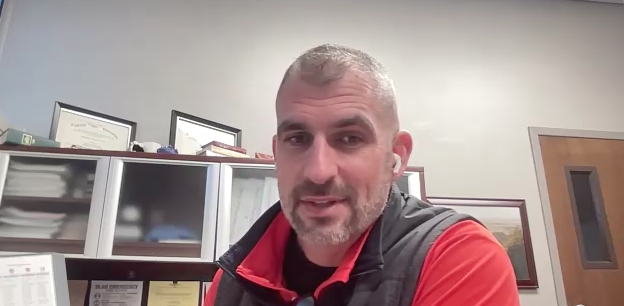
Found a mistake? Have a news tip or feedback to share? Contact our newsroom using the button below:
citizen journal offers three flagship products: a daily national news summary, a daily Kansas news summary, and local news and school board summaries from 20 cities across Kansas. Each issue contains 5 paragraph-length stories that are made to be read in 5 minutes. Use the links in the header to navigate to national, kansas, and local coverage. Subscribe to each, some, or all to get an email when new issues are published for FREE!
