Fewer Students, Bigger Bills
How declining enrollment is reshaping USD 418's finances, facilities, and future


On March 3, 2026, USD 418 voters will decide on an $89.5 million, two-part bond election that could shape our school district's future for decades to come. As local residents prepare to cast their ballots, questions abound about what this funding would support, how it would be implemented, and what it means for our community.
Over the coming weeks, this investigative series will examine USD 418 from several angles—through district records, facility assessments, and conversations with administrators, teachers, parents, and students. Our goal isn't to tell you how to vote, but to cut through rumors and provide the facts you need to make an informed decision.
Education is the cornerstone of our community. Whether you're a parent, taxpayer, or concerned citizen, you deserve transparency about how your schools operate and what this bond would mean. Join us as we shine a light on USD 418 and ensure every voter can participate with confidence.
McPherson has always been a community that invests in its children. But a quiet demographic shift—years in the making and accelerating fast—is forcing USD 418 to confront an uncomfortable reality: the district has more building capacity than it has students to fill it, and the funding formula that keeps the lights on is tied directly to the number of kids walking through the door. Understanding how we got here is essential to casting an informed vote.
The Numbers Tell the Story
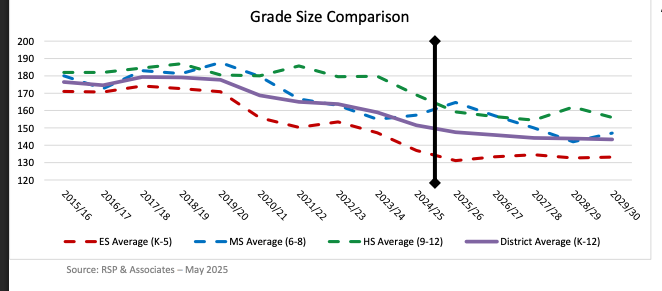
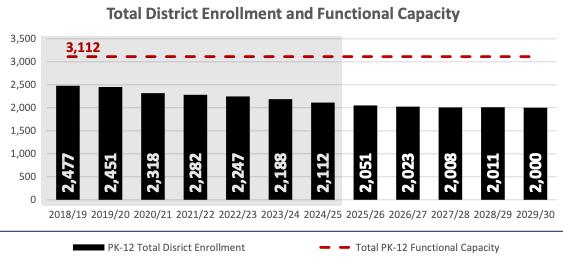
USD 418 enrollment peaked at 2,477 students in 2018-19. This year, it stands at 2,112—a loss of 365 students, or roughly 15 percent, in just six years. The decline has averaged 2.6 percent annually, and the RSP & Associates enrollment study commissioned by the district projects another 110-student drop by 2029-30. The pattern is stark at the classroom level: this year's kindergarten class enrolled just 109 students, while the graduating senior class numbered 182. When larger classes walk out the door each May and smaller ones walk in each August, the math moves in only one direction.
McPherson County live births have fallen below 300 per year in three of the last five years, down from 343 a decade ago. The district's share of those births enrolling in kindergarten has also slipped, meaning fewer local children are entering the pipeline to begin with.
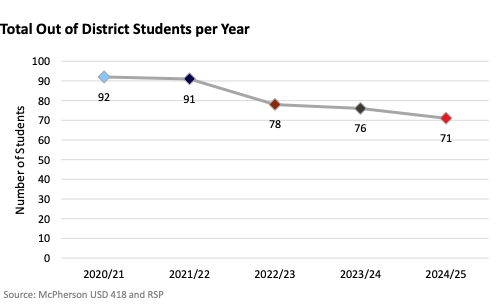
The transfer picture has shifted too. Three years ago, the district saw a net gain of 20 transfer students. That trend has reversed—the RSP study documents net losses in each of the last two years, with 33 more students leaving than arriving in 2024-25, choosing homeschool, virtual options, or neighboring districts. District officials acknowledge this outflow. I have a good friend whose son attended McPherson Middle School and then elected to attend Smoky Valley for high school rather than McPherson High School. Most people in town have similar stories.
Not Just McPherson: A Statewide, National, and Global Trend
Kansas statewide public school enrollment has fallen roughly 16,000 students from its 2015 peak. Two-thirds of Kansas districts lost enrollment over the past five years. Nationally, public school enrollment peaked at 50.8 million in 2019 and is projected to drop to 46.9 million by 2031. The U.S. fertility rate hit a record low of 1.6 births per woman in 2023—well below the 2.1 replacement level. Kansas sits slightly above the national average at about 1.7, but the trend line points the same direction.
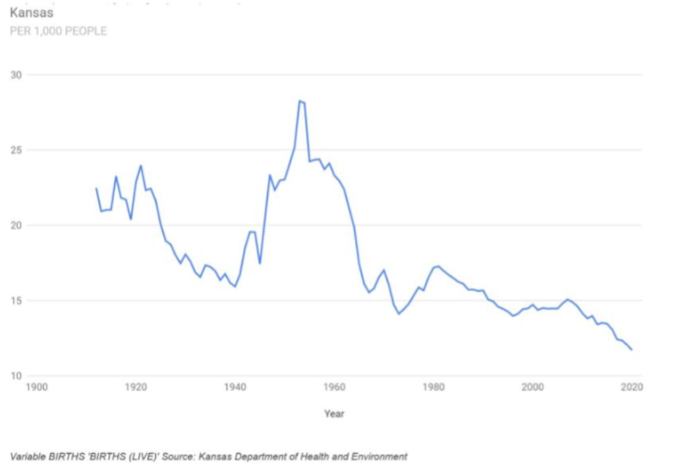
Globally, the world fertility rate has fallen from 5.3 births per woman in 1963 to 2.1 today, and by 2100 nearly every country on Earth is expected to fall below replacement. Two primary forces drive this in McPherson County and communities like it.
First, industrialization transformed agriculture. A century ago, a McPherson County wheat farm needed a large family to operate—children were essential labor for planting, harvesting, and tending livestock. Modern mechanization replaced that need. A single operator with GPS-guided equipment can now manage ground that once required a dozen hands. Families got smaller because the economic incentive for large families disappeared. This is not unique to Kansas—it is the defining demographic story of every industrialized society on Earth.
Second, brain drain hollows out rural communities. As I explored in my article American Brain Drain, small and mid-sized communities across America are caught in a cycle: they invest in educating talented young people who then leave for metro areas offering higher wages and more career options, rarely to return. McPherson raises excellent students—and then watches many of them build lives in Wichita, Kansas City, Denver, and beyond. The population loss compounds the birth-rate decline, further shrinking the school-age pool.
Impact on Capacity, Operations, and Funding
USD 418's six school buildings have a combined functional capacity of 3,112 students. Current enrollment of 2,112 means the district is operating at just 71 percent utilization—and falling. RSP recommends 85 to 90 percent utilization for efficient operation. Empty classrooms are not free—they still require heating, cooling, maintenance, and insurance.
Kansas funds schools primarily through a per-pupil formula—the state multiplies a district's weighted enrollment by a base amount ($5,378 per student for FY 2025) to determine its aid. 365 fewer students at $5,378 per pupil means roughly $1.96 million less in base state aid annually. Fewer students means less money, period. Federal funding works the same way. Yet fixed costs—building maintenance, utilities, transportation routes, administrative staffing—do not shrink proportionally when enrollment drops. The district faces a widening gap between what it costs to operate aging facilities built for a larger student body and the revenue those facilities generate.
Why March 3 Matters
Declining enrollment is not a failure of our schools. It is a demographic reality driven by forces far larger than McPherson. But how we respond to it is a choice. The question before voters on March 3 is whether to invest now in matching facilities to enrollment, or continue paying to maintain buildings that fewer students use each year.
Found a mistake? Have a news tip or feedback to share? Contact our newsroom using the button below:
citizen journal offers three flagship products: a daily national news summary, a daily Kansas news summary, and local news and school board summaries from 20 cities across Kansas. Each issue contains 5 paragraph-length stories that are made to be read in 5 minutes. Use the links in the header to navigate to national, kansas, and local coverage. Subscribe to each, some, or all to get an email when new issues are published for FREE!
