BPU Says Proposed 'Infrasound' Regulation Will Raise Electric Rates
Utility also says neither existing nor new industry could meet the rules, effectively barring development



Sign up for our free newsletter and never miss a story.
Sign up freeMCPHERSON, Kan. — McPherson County commissioners declined Monday, Sept. 28, to act on a proposed resolution that would limit infrasound and low-frequency sound in the unincorporated county, after the general manager of the McPherson Board of Public Utilities told them it would block the utility's plan to replace aging power plants and drive up electric rates. All three commissioners said the county should take more time and hear from acoustic experts before adopting any rule. They took no vote and set no date to bring the measure back.
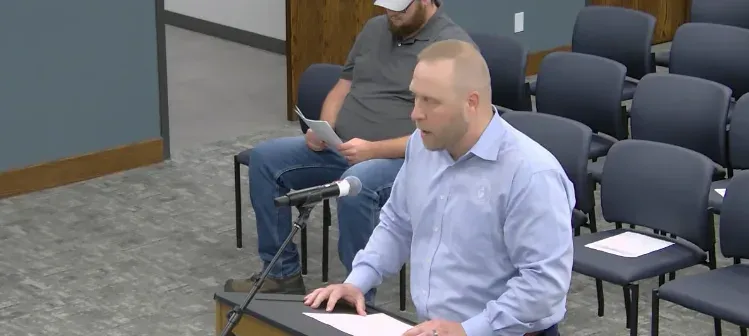
Josh Bedel, BPU's general manager, spoke during public input before the item was presented. He said the utility has spent years developing a project to address its aging generation infrastructure, and that the resolution "as it's written today" would keep BPU from expanding its Power Plant 3 site, which "will have an extremely negative effect on our electric rates" for the more than 9,000 customers the utility serves.
He said no industrial partner in the county — including CHS, Williams, Enterprise, ONEOK, Pfizer, Viega, Johns Manville and MKC — could meet the standard, and that he was not sure a farmer with a center-pivot irrigation system could. Bedel said county staff had told BPU and industry they were not in a hurry and would have months to help develop the rules.
"We were lied to," he said. "We were not given months. This all happened in a matter of weeks." He said he learned the resolution was up for a vote when the agenda was shared on social media, and he urged commissioners to hear from acoustic experts before considering any regulation.
Infrasound is airborne sound below 20 hertz, beneath the range of normal human hearing, and the draft also covers low-frequency sound from 20 to 200 hertz. The resolution would cap infrasound at 3 decibels above the existing background level and low-frequency sound at 5 decibels above background, measured at the edge of a residential district or the property line of a home, school, church or care facility, and would limit audible sound outside a dwelling to 50 decibels by day and 40 at night.
According to a Purdue University noise chart, 40 decibels is the level of a library and 50 decibels a quiet suburb or a large electrical transformer heard from 100 feet. According to acoustics firm AcoustiTECH, a 3-decibel change is "barely perceptible" to the ear.
No federal standard governs infrasound: the Environmental Protection Agency closed its noise office in 1981 and left noise regulation to state and local governments, and federal workplace noise limits are set by loudness, not frequency. Statewide wind-farm rules in Wisconsin and Maine cap turbine noise at 45 and 42 decibels at night, respectively, and Maine adds a 5-decibel penalty for tonal sounds, but neither sets a limit below 20 hertz.
Loudoun County, Virginia, center of the nation's largest data center cluster, says it has no rules "specific to tonal noise or low frequency noise." Neighboring Prince William County's ordinance, adopted in October 2025, measures data center hum on a C-weighted decibel scale rather than by frequency band. A Citizen Journal search found no Kansas county with an infrasound limit.
Jon Kinsey, listed on the agenda as the county's planning, zoning and environment director, told commissioners he was "addressing you this morning as the Board of Health" and that the resolution "is not coming from planning and zoning." Under Kansas law, the three county commissioners also serve as the county board of health, so the same officials would act on the measure either way.
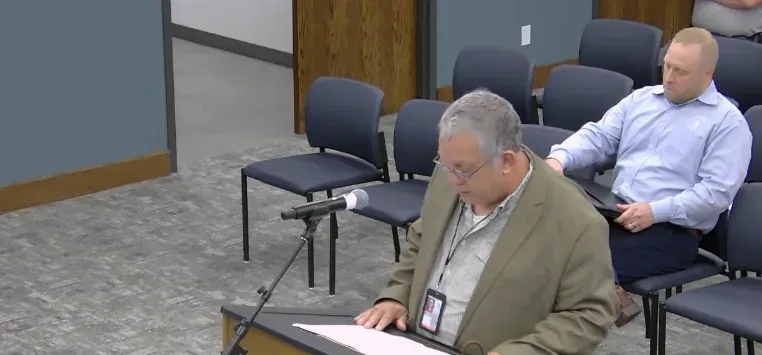
But the agenda placed the item under Kinsey's planning title. The draft is written as a Board of County Commissioners resolution that cites the county's home-rule authority rather than public health statutes, with signature lines for the commissioners, the county clerk and the county counselor and none for a health official.
Kinsey said he was presenting because health department director Shalei Shea had a scheduling conflict.
Speaking on behalf of the McPherson County Health Department, Director and Health Officer Shalei Shea told Citizen Journal Tuesday she has not taken a position for or against the proposed infrasound resolution. Shea said she first learned of the potential resolution from Planning, Zoning and Environment Director Jon Kinsey in May. She called for clarification of departmental roles and the process and authority for bringing the proposal before commissioners acting as the Board of Health, and said additional evidence and public input are needed before moving forward.
The proposal follows the commission's unanimous Aug. 31 vote adopting Resolution 2026-21, which banned data centers, utility-scale battery storage and hydrogen energy systems from the unincorporated county, making McPherson among the first Kansas counties to do so. The county planning board had recommended the ban on a 5-2 vote. Bedel said Monday the infrasound proposal "has the ability to single-handedly undo everything that McPherson County has built for the last 50 to 70 years," and asked why county staff were "going after BPU and all of the other industries in the county" after the data center ban.
Experts contend those industries provide jobs and wages that help support McPherson County’s relatively high household incomes. According to Census Bureau estimates compiled by the University of Kansas Institute for Policy and Social Research, McPherson County's estimated median household income of $78,212 in 2024 ranked 10th among Kansas' 105 counties and above the statewide figure of $75,402. County officials say the rules are meant to protect rural residents. Kinsey said the intent was to protect residents' homes, "their biggest investment."
This article was written using our proprietary AI system, Cronkite. The final decision to publish this article was made by a human. For more info, read our AI policy.
Found a mistake? Have a news tip or feedback to share? Contact our newsroom using the button below: